
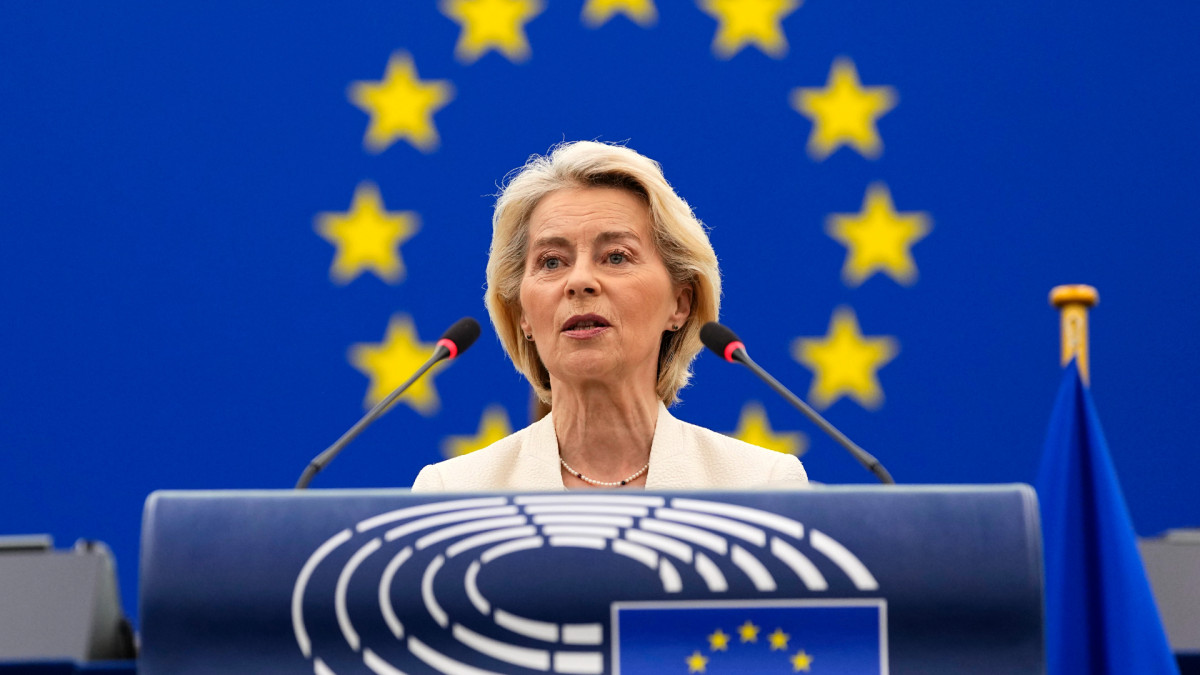
Last Wednesday, Ursula von der Leyen, president of the European Commission, delivered her sixth State of the Union address (SOTEU), the long-standing annual kickoff for the European Union’s political year. It was a speech to the Plenary of the European Parliament gathered in Strasbourg, where the head of the European executive defended her management over the last year and outlined the challenges for the coming months. This edition is also special: with a turbulent electoral year ahead and a 2028 that will depend entirely on the results of those elections in places like France, Spain, or Italy, Von der Leyen finds herself in the final stages of the period during which she can still shape her legacy before the end of the mandate.
“Von der Leyen is in the final stretch of the time during which she can still shape her legacy before the end of the mandate”
The president of the European Commission does well to identify a world that is moving ever faster and that is, in her own words, “openly hostile” to the European model. Any citizen who hears that analysis would afterwards expect a display of leadership, a more or less firm response to the obvious question: okay, if that is the case, then what? There was a single and timid answer from Von der Leyen, completely buried within the speech, an idea overshadowed by the proposal to turn Canada into an “associated member,” a status whose meaning nobody knows exactly.
“The absence of new proposals does not translate into the ones already on the table advancing more decisively”
In many instances, Presidents of the European Commission have entrenched themselves in a bureaucratic and administrative profile. Until not long ago, that was, literally, their job. From that have descended speeches that merely enumerate legislative proposals and technicalities, renouncing the more political arena. That has become increasingly difficult as a world that is ever more complex demands greater European-level leadership. A narrative that helps citizens, businesses, and other relevant actors understand the moment they are living in.
The moment the world and Europe are going through requires offering that narrative, those key ideas that help navigate daily life. And although those ideas are there, the leaders, Von der Leyen among them, are failing to convey them clearly. The SOTEU of 2025 was, in this sense, much more on target than that of this year.
“Although those ideas are there, the leaders, including Von der Leyen, are failing to convey them clearly”
The reality is that Members of the European Parliament and any hapless European citizen looking toward Strasbourg will have found more inspiration in the intervention by Mark Carney, Canada’s prime minister, than in Von der Leyen’s speech or in any address a European leader has delivered in the European Parliament in recent years. A speech with roots in Goethe, in the twentieth century, in the limits of sovereignty and in the need to forge alliances based on the issues defended, not on those opposed. The Canadian prime minister sacrificed talking too much about programs and economic data in exchange for offering a comprehensive view of the current moment. That speaks well of Carney, but above all it speaks quite poorly of the Union’s political leaders.
