
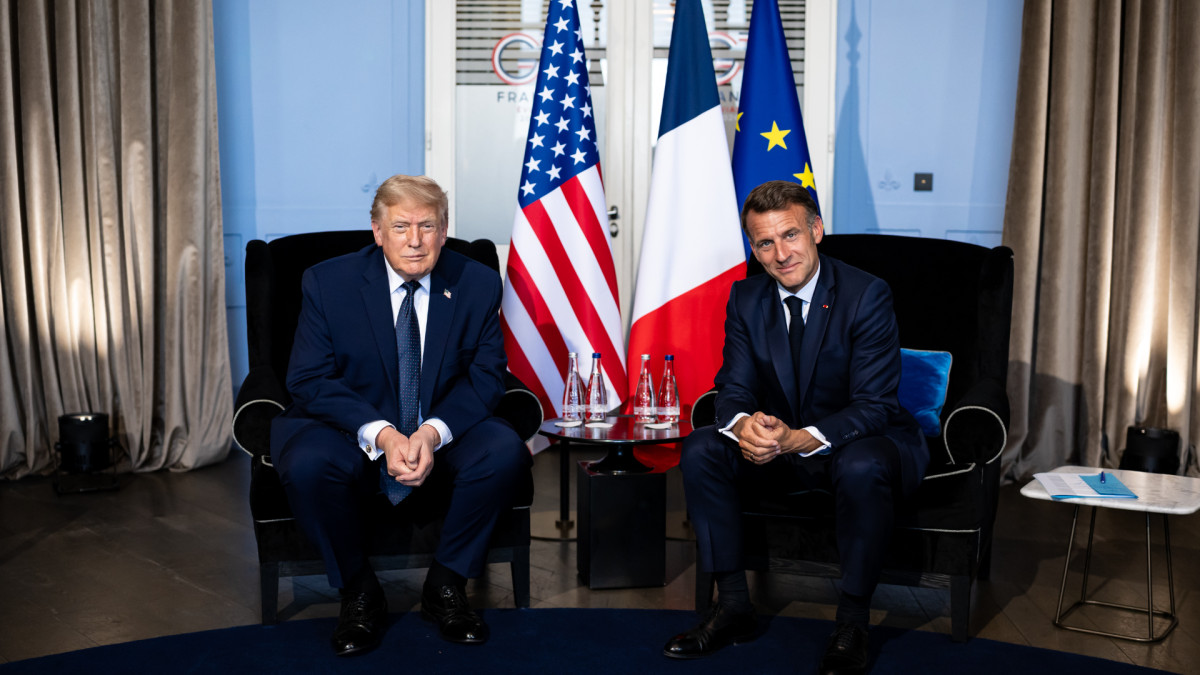
The G7 summit held this week in Évian, France, left a image that fairly well captures the current state of the international system, one in which the leaders of the world’s major industrialized democracies gather around a table while trying to manage simultaneously the war in Ukraine, the escalation in the Middle East, the rivalry with China, and the growing global economic tensions. Too many fires to fight for a club that, although still influential, no longer has the capacity to order the world as it did for decades.
“The sense of transition, of a relative loss of Western centrality, has been present throughout the summit”
In fact, perhaps the main conclusion of this gathering is not so much what was agreed as what it reveals about the evolution of global power. The G7 continues to represent a substantial portion of global wealth, but more and more it struggles to translate that economic heft into an effective ability to resolve conflicts or to build broad international consensus. The sense of transition, of a relative loss of Western centrality, has been present throughout the summit.
However, if there was one issue that drew much of the political and media attention, it was Ukraine. And not merely because Volodymyr Zelensky was present, but because the gathering occurred at a particularly delicate moment for Kyiv. After months of uncertainty about American commitment, Europe needed to gauge to what extent Donald Trump was willing to maintain Western backing for Ukraine or, alternatively, to move toward a strategy of accommodation with Moscow.
The results seem to have been better than many had expected. The final statement reaffirmed the G7’s support for Ukraine’s sovereignty and territorial integrity and announced an increasing economic pressure on Russia, especially in the energy sphere. The leaders agreed to intensify sanctions on the Russian economy and maintain military support for Kyiv.
More than the final text, the most notable development was the shift in tone observed in Washington. In early 2026, Trump had maintained an ambiguous stance on the war, alternating messages favorable to a quick negotiation with criticisms of the Western strategy of ongoing support for Ukraine. In Évian, however, the coordinated pressure from European leaders appears to have had some effect.
It is no accident that Emmanuel Macron, Friedrich Merz, or Keir Starmer have devoted a large portion of their diplomatic efforts to persuading the American president that a reduction in support for Ukraine would not lead to peace, but would probably consolidate Russian positions on the ground. According to various reports published during the summit, Trump would have shown greater willingness than expected to again tighten sanctions on Moscow and to increase military support for Kyiv.
“A reduction in support for Ukraine would not lead to peace, but probably to a consolidation of Russian positions on the ground”
Nevertheless, this shift should not be interpreted as a full alignment with European positions. The US administration continues to view the conflict through a different logic. For the European Union, the war in Ukraine is an existential issue directly tied to continental security, while Washington increasingly frames it within a global strategy in which China remains the main strategic challenge.
In this sense, the gap between priorities continues to define the pace of the transatlantic relationship. This, highly sensitive, is one of the fundamental questions the European Union will have to address in the coming years, because it forces it to assume greater responsibility for its own security.
The war in Ukraine has shown that the EU can act with a unity and determination that few anticipated in February 2022. But it has also exposed to what extent it remains dependent on the United States in military, technological, and intelligence aspects. Whenever the political climate in Washington shifts, European capitals are faced again with the same question: what would happen if ?
The Évian summit, even without solving the issue, has brought it back onto the table.
“Whenever the political climate in Washington shifts, European capitals are faced again with the same question”
At the same time, Ukraine has shared the spotlight with another crisis that threatens to destabilize the international stage even further: the Middle East. The escalation between Israel and Iran has compelled the G7 to devote a significant portion of its deliberations to regional security, energy routes, and risks to the world economy. The paradox is evident. While Europeans attempt to keep the international focus on Ukraine, events in the Middle East compete once again for political and media attention. It is not a minor issue for Kyiv. Each new international crisis entails a contest for resources, diplomatic attention, and political capacity.
Precisely for this reason, Zelensky insisted during the summit on the need to prevent the war in Ukraine from disappearing from the international agenda. And he probably has a point. Experience shows that protracted conflicts tend to face a phenomenon of political fatigue in the societies that observe them from the outside.
In parallel, the G7 leaders have debated economic security, supply chains, and dependence on technology. The concern about China remains one of the few elements capable of generating relatively broad consensus among Western partners. The issue of critical minerals, essential for the energy transition and new technologies, has occupied a prominent place in the discussions.
Yet here too there is no completely homogeneous position. Europe continues trying to find a delicate balance between reducing strategic risks and preserving its economic ties with Beijing. The United States, by contrast, seems to be moving toward a logic of increasingly intense structural competition.
“Protracted conflicts often face a political fatigue phenomenon in the societies observing them from the outside”
The final sense is that the G7 continues to function as an essential coordination space for Western democracies, but increasingly conditioned by a much more fragmented and competitive international context. The era in which decisions taken in this forum could by themselves determine the course of the international system belongs to the past.
Perhaps that is why the most important question this summit leaves behind is not Ukraine, nor China, nor even the Middle East. The fundamental question is whether Europeans are capable of adapting to a world where American leadership can no longer be taken for granted, where the relative weight of the West gradually declines, and where the weight of Europeans ceases to be central on the global stage.
What we have witnessed in Évian these days has been more than a diplomatic gathering. In France there has occurred a new demonstration that we are entering a stage of geopolitical transition in which old certainties disappear faster than we are able to build new ones.
