
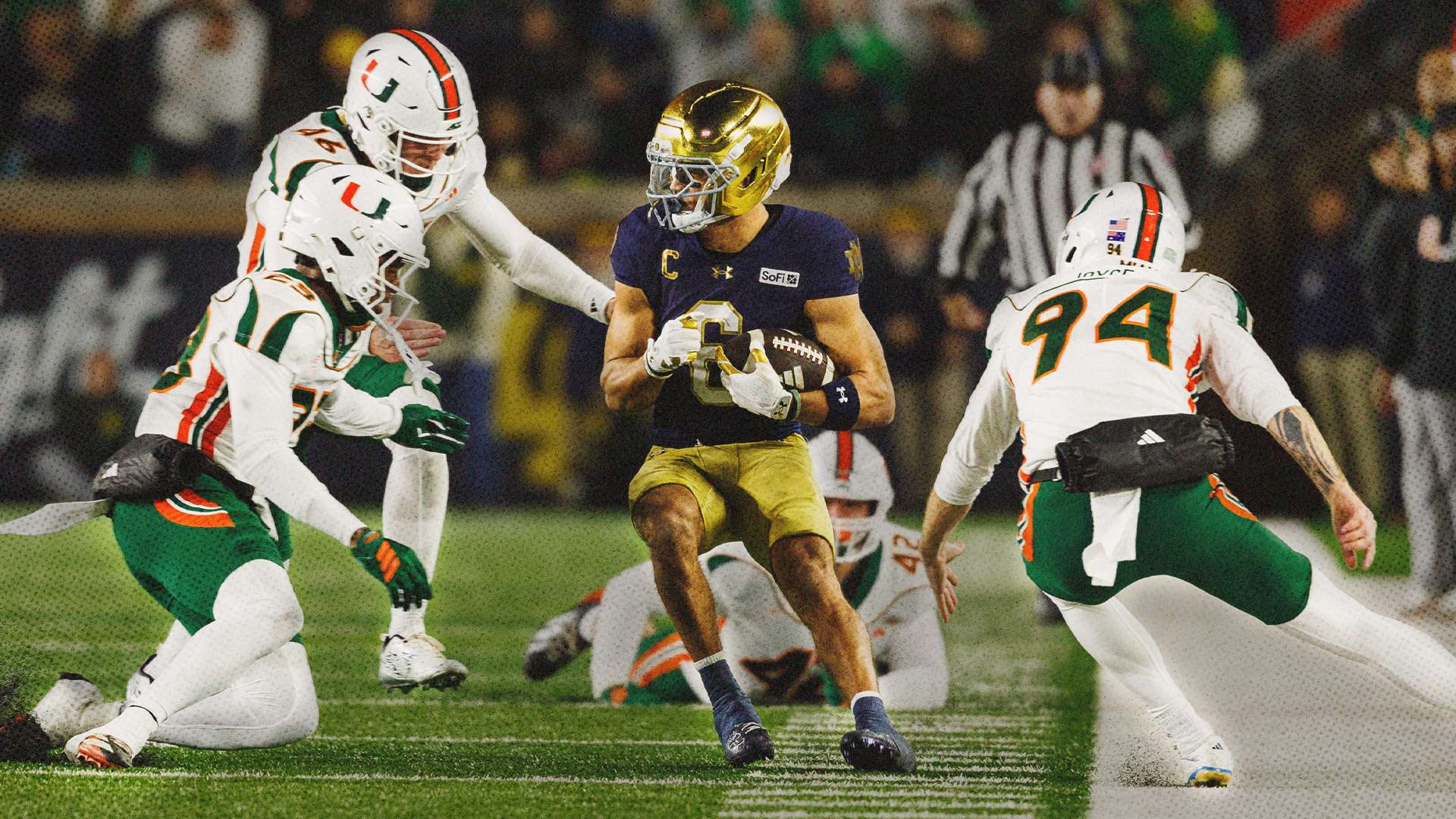
Regulating college athletics may be stalled for the moment, yet the consequences could grow far more severe as time goes on.
Greetings and welcome to another edition of Free Agent! This week presents a good moment to flip that coin.
With Democrats taking the reins in Congress, we’ll dissect at length what that could mean for college athletics, then branch out to a few additional angles before finishing with thoughts on NASCAR’s refreshed playoff system.
Catch coverage of sports from Jason Russell and Reason.
Locker Room Links
- The College Football Playoff expansion to 24 teams is official. (Not great!)
- From Awful Announcing: “Is a sports media blue wave coming, too?“
- Blue Jays player Anthony Santander was not happy that Michigan Democrat Abdul El-Sayed won his Senate election and reposted two Instagram videos that said “America voted for Sharia” and “Islam is not peaceful.” The Blue Jays distanced themselves from the statement.
- After an international court ruled that Russia must be allowed in international hockey tournaments, the Canadian government is refusing to issue visas to Russians for the upcoming World Junior Ice Hockey Championships.
- Colorado passed a higher income tax, and the state’s professional athletes are getting hit with it. (Those states with no income tax must look nice!)
- The SEC might implement a luxury tax to discourage high spending on athletics. (We’ll see if Democrats and the courts have anything to say about that.)
- Voters in Pickerington, Ohio, keep rejecting tax increases, so the school district cut nonvarsity sports.
- Elsewhere in Reason: “California Voters Reject 5% Billionaire Wealth Tax“
- God bless the people who do things like systematically grade field stormings in their free time:
Notre Dame just stormed the field as a 7-point favorite.
Grading every field storm since 2019 on:
– the line
– who you beat
– your own program
– how close to defeatBeating No. 1 counts for a lot.
Being a home favorite counts against you.This grades as a D, 14th worst https://t.co/Jks7k9xIwP pic.twitter.com/qgzHzcfsgQ
— Stick to the Model (@StickToTheModel) November 8, 2026
The Midterms Upended the Push for College Sports Regulation
By now you’ve likely seen that the Democrats rode a sweeping victory in the 2026 midterms. The real question is what happens if that same dynamic repeats in 2028, and how federal oversight of college athletics could shift as a result?
The Protect College Sports Act (PCSA) made it through the Senate in September. Despite numerous concerns surrounding it, its sponsors are banking on the House to advance it promptly after recess. (I’m old enough to recall when Sen. Ted Cruz [R–Texas] predicted the House would return early so President Donald Trump could put his stamp on the bill during GameDay before the midterms.)
Yet the recent blue wave might prove the final nail in the coffin for the PCSA—or at least for this particular version of it.
“If you want a quote, here it is,” the aide said, “the NIL bill is dead on f****** arrival.”
It’s time for college sports to move on from the PCSA. https://t.co/bQrf5FEcM2
— Mit Winter (@WinterSportsLaw) November 5, 2026
So why would the Democratic side gift former President Trump a legislative win? Why not let two years pass, hoping a new Democratic administration could sweep into power with even larger majorities in Congress? And if that scenario materializes, what would a purely partisan Democratic version of the bill look like? It could alter the course of college sports in ways that are hard to predict.
Several 2025 proposals from Democrats provide a useful glimpse.
The more conventional plan from the party last year was the Student Athlete Fairness and Enforcement (SAFE) Act. Like the PCSA, it bears some fingerprints from Sen. Maria Cantwell (D–Wash.), creating substantial overlap with the PCSA in several areas. Both measures would permit conferences and schools to jointly negotiate media rights under antitrust exemptions. The PCSA, however, offers a shield against antitrust suits for NCAA and conferences when enforcing its rules, while the SAFE Act does not provide such protection. The PCSA sets a cap on compensation to athletes; the SAFE Act leaves the current cap untouched. The PCSA codifies the NCAA’s newly adopted five-year eligibility rule; the SAFE Act does not codify that change, as it preceded it. The PCSA allows one free transfer; the SAFE Act allows two (with some exceptions that allow more). Essentially, the PCSA blocks power conferences from merging, while the SAFE Act does not.
The SAFE Act does not address student-athlete employment status, whereas the PCSA states neutrality on that point. A more aggressive Senate proposal, the College Athlete Right to Organize Act, sponsored by Sens. Chris Murphy (D–Conn.), Elizabeth Warren (D–Mass.), and Bernie Sanders (I–Vt.), is tighter and narrower, but explicitly recognizes student-athletes as employees of their colleges with rights to collective bargaining with their schools and conferences (though not with the NCAA). That bill never progressed out of committee, and its three cosponsors voted against the PCSA. It’s reasonable to expect that they and other Democrats would press to include union rights for college athletes in any future legislation.
Then there’s the College Athlete Economic Freedom Act, introduced by Murphy without Senate cosponsors. This bill would bar the NCAA and conferences from constraining name, image, and likeness (NIL) payments unless those limits are reached through collective bargaining. It would allow athletes to organize and be represented by a union, agent, or attorney. It would require collectives to register with the Federal Trade Commission and prohibit discrimination by gender, race, or sport in NIL arrangements for any given school. It also contemplates a new visa category for international athletes and argues that NIL payments would not breach visa terms.
Taken together, these three proposals align on the core elements of the PCSA but add a stronger push for athletes to organize collectively. The question remains whether Democrats can push such provisions through, or whether union rights would rally NCAA members, conferences, and schools to mount a broad political counterweight.
In the meantime, expect college sports to continue expanding and prospering even without heavy federal intervention.
If Democrats Take Control, What About Everything Else in Sports?
Suppose Democrats secure full control of the federal government in 2028—what other moves might they attempt in the sports realm?
Prediction markets and sportsbooks could face particularly rough seas. If the courts don’t settle the matter before 2029, a Democratic administration could roll back regulations that treat prediction markets as sports betting, effectively subjecting them to state gaming rules. Advertising restrictions during live broadcasts and prohibitions on college-athlete prop bets might also be on the table, as proposed by Sen. Richard Blumenthal (D–Conn.).
The federal government could also get more involved in regulating television broadcasts, potentially reshaping the economics that drive modern leagues. Sen. Tammy Baldwin (D–Wis.) has introduced legislation requiring major professional leagues to provide a free, live-stream option for residents of a team’s home state. It would also ban local blackouts on out-of-market league streaming services. Some Democrats want to strip leagues of antitrust exemptions that let teams pool media rights for greater revenue. If TV revenues were to dip, the natural fallback for leagues would be to raise ticket prices for fans.
There’s also the possibility that lawmakers could push to require transgender athletes to compete according to the gender they identify at birth, or conversely require female sports to include transgender athletes—along with other Title IX–related shifts. Recall that a prior administration explored the idea of spending “proportionate” NIL funds for male and female athletes under Title IX; a future president might attempt a similar approach, even if it ends up facing court challenges.
Another avenue could be direct federal funding for Olympic sports, an approach that looks appealing until you weigh the ballooning national debt and the political meddling such a program would invite into what has historically worked well as a voluntary, decentralized Olympic model.
At the state level, blue states would likely pursue tax increases on the wealthy, which could widen the appeal of several red states without income tax for free agents weighing where to sign.
Under a Trump administration, conservatives have not shied away from involving the federal government more in sports recently (as the PCSA push has highlighted). If given a fresh chance after the next presidential contest, expect Democrats to push in the opposite direction with similar vigor.
NASCAR’s Great New Playoff Format Spreads Out the Drama
NASCAR stands out as one of the few major sports in recent memory that deliberately moved away from manufactured suspense. While many leagues keep expanding postseason rosters and chase after game-seven-type tension, NASCAR experimented with a decade-long approach and then chose a different path.
Previously, the playoff system trimmed the field from 16 drivers down to four across three elimination rounds, culminating in a final race to crown the champion. The current format mirrors that structure but resets the points for 16 drivers and tallies results across 10 races, with the regular-season order granting advantages. In this setup, a dominant driver might clinch the title before the final event, while several contenders still have a shot in the last race, providing a different kind of climactic pressure.
As a longtime NASCAR admirer (even if I drifted away for a spell in the 2010s), I found the revamped system engaging. It made every playoff race feel meaningful—before, I mainly cared about the two or three eliminators and the final. Victory in a race yields a substantial points boost, yet consistently strong finishes can still carry the day. This season’s champion, Kyle Larson, reached the most playoff wins (three of ten), but the runner-ups collectively notched barely more than one win in the playoffs.
Still, you can nitpick the format. The moment of clinching the title felt a little anticlimactic—Larson was declared champion not by crossing a finish line first, but by accumulating enough points at the end of the opening stage of the championship race (NASCAR divides races into three stages, with top-10 stage finishes earning points). The act of clinching in the middle of a race is a touch underwhelming. (Formula 1 faced a similar quirk in 2023 when Max Verstappen captured the title by finishing second in a sprint race rather than at the end of a traditional grand prix.)
Replay of the Week
College basketball is back, and the scoreboard keeps catching players scoring into the wrong basket. (At least New Mexico State managed to win nonetheless.)
OH. MY. GOD. 🤯 New Mexico State just put a layup into THEIR OWN BASKET in the final 20 seconds trailing by 1 Point. pic.twitter.com/oz9IFp40bz
— NCAA Buzzer Beaters & Game Winners (@NCAABuzzerBters) November 6, 2026
Today’s off to an interesting start.
A college basketball player scored on the wrong basket. pic.twitter.com/N3HnAWGQR0
— Talia Goodman (@TaliaGoodmanWBB) November 6, 2026
That wraps up this edition. Grab your weekend entertainment by tuning into the big game elsewhere: this year’s Canadian Football League Grey Cup match between the Montreal Alouettes and the Edmonton Elks (Sunday at 6 p.m. Eastern, on CBS Sports Network).
</div><script async src="https://platform.twitter.com/widgets.js" charset="utf-8"></script>
Natalie Foster
I’m a political writer focused on making complex issues clear, accessible, and worth engaging with. From local dynamics to national debates, I aim to connect facts with context so readers can form their own informed views. I believe strong journalism should challenge, question, and open space for thoughtful discussion rather than amplify noise.