
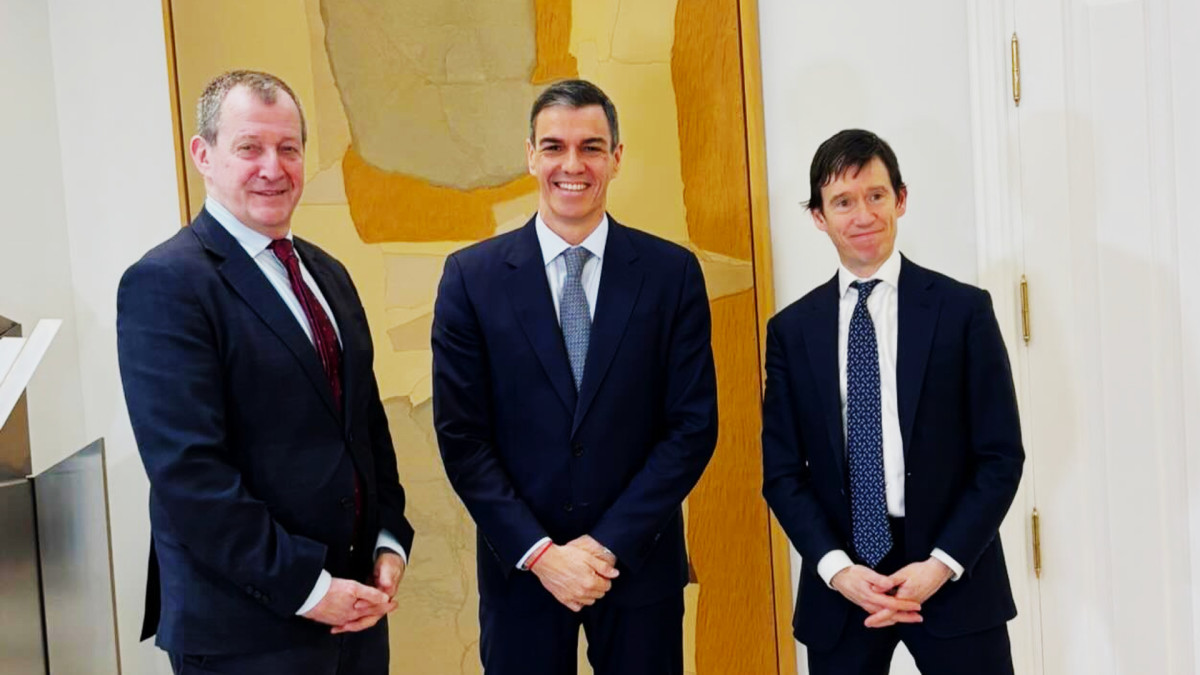
Alastair Campbell, the strategist who for a decade helped build Tony Blair’s political project, welcomed me in London a few months after he had spent an hour speaking with Pedro Sánchez on his podcast The Rest Is Politics. In front of Spanish interviewers, the interview with Sánchez would have revolved around issues such as amnesty, judicial investigations, polarization, etc.
Nevertheless, that was not what caught Campbell’s attention. He perceived the Spanish president as “Very clear. Very coherent. Very composed” (very clear, very coherent, very composed), he summarized for me. In other words, what impressed him most was not a specific answer but the absolute control of the pace of the conversation. Even when the interview touched on investigations affecting people in his circle, Campbell recalls that the president’s gesture hardly changed. He neither lost his composure nor gave the impression of feeling uncomfortable. And I think this is a huge difference between Spanish political discourse and the international one that deserves reflection.
It is clear that Spain continues to analyze Pedro Sánchez as a domestic phenomenon —the leader who divides the country, who survives against the odds and who governs without a clear parliamentary majority— but outside our borders a different reading is beginning to take shape, in my view, much more interesting.
Perhaps an alternative conversation would be more compelling, not about why Sánchez manages to stay in La Moncloa and for how long, but about how a country that for decades barely featured among the major European political capitals has begun to occupy a central place in some of the continent’s main discussions.
“Spain continues to analyze Pedro Sánchez as a domestic phenomenon, but outside our borders a different reading is beginning to take shape”
“The international position of Spain has changed”, Campbell says quite naturally. For years, he explains, Europe was dominated by a small group of capitals —Paris, Berlin and London, with Rome or Warsaw occasionally joining the conversation—, while Spain remained in a discreet second plane. Today, he argues, Madrid is expected to have a position on the major strategic issues of the world. Because perhaps the most striking feature of contemporary Spain is not the intensity of its polarization, but the growing contrast between how the country is perceived from within and how it is starting to be observed from outside.
Madrid continues to absorb national politics, as one would expect. But while Brussels watches influence and begins to think about leadership, Spain remains focused on talking about parliamentary coalitions. In this context there is no such thing as a “correct” conversation and another as “incorrect”. What can be said is that there is an important difference,
Before the rise of globalization, and for much of it, there existed a relatively clear boundary between domestic politics and foreign policy. Prime ministers could delegate much of the international affairs while concentrating their political capital on the economy, taxes or the welfare state.
Now it seems that that order has run dry. For that reason, Campbell insists several times during the conversation that governing today means doing both things at once. Immigration, energy, artificial intelligence, the war in Ukraine, food security, trade or technological rivalry with China are nothing but domestic policy by other means.
“As Brussels watches influence capacity and begins to think about leadership, Spain remains focused on talking about parliamentary coalitions”
And there, in his view, Sánchez seems to feel especially comfortable. From the outside it is striking to see to what extent many positions that looked extravagant only eighteen months ago have ended up moving to the center of the European debate. Campbell mentions two obvious examples: the stance toward Donald Trump and Spain’s position on Gaza. When Sánchez began publicly challenging certain American positions or was one of the first European leaders to harden his tone regarding the Israeli offensive in Gaza, a significant part of the Spanish conversation interpreted those moves as signals of international isolation.
Yet the former Labour adviser sees it exactly the opposite. “Sometimes leadership consists in arriving before others”, he summarizes. In that contrast there are some very valuable clues for understanding why Spanish politics is sometimes so hard to explain outside the country. Here, the most common pattern has been to frame each case as a particular issue; abroad, perhaps because Spain is one among many topics, a more linear strategy was detected.
It is probably the most intriguing part of my conversation with Campbell. He rejects the most frequent critique of Sánchez — that he keeps changing position — through that classic British distinction between strategy and tactic. “He has shifted concrete positions. No doubt. Has he fundamentally changed his political project? I don’t think so,” he replies. “What I see is someone who tactically adapts his positions to pursue an extraordinarily coherent strategic vision.”
There is a notion in Alastair Campbell that functions almost as a critique of contemporary political journalism. In the United Kingdom there is even an expression for it: humiliating U-turn. It is the automatic headline that accompanies any prime minister’s change of position. Campbell rejects that logic. Confusing any tactical adjustment with a strategic renunciation —he argues— is one of the great errors of current political coverage. Governing in a changing world requires modifying decisions; what defines a leader is not the absence of U-turns but the coherence of the path he or she is pursuing.
The reflection Campbell offers goes beyond the Spanish case. Western democracies coexist with political fragmentation that obliges governments to sustain shifting coalitions, while international crises frequently alter national priorities. Under those conditions, ruling for ten years without revisiting any concrete stance would be incompatible with reality.
Campbell argues that a change of opinion should not be judged apart from the facts. There is a phrase attributed to Keynes that sums it up perfectly: “When the facts change, I change my mind. What do you do?”.
“What I see is someone who tactically adapts his positions to pursue an extraordinarily consistent strategic vision”
The distance between the Spanish and the international perception of Sánchez may partly relate to that way of understanding leadership. Many foreign observers do not follow every episode of national politics. They see, above all, a leader who has built a relatively coherent discourse about the place he wants for Europe in a less stable and more competitive world. Strategic autonomy, European integration, immigration as an economic necessity, the energy transition and artificial intelligence appear in that discourse as parts of the same political project. Whether one agrees or not, the project has recognizable contours, more visible when viewed from the outside.
Campbell takes the reasoning even further and asks whether many Spaniards have yet to recognize the type of leader they have before them. Instead of trying to judge him as better or worse than his European counterparts, he places Sánchez in a different generation, formed by leaders who govern assuming that domestic politics can no longer be separated from geopolitics, technology or the competition among great powers.
Is there any guarantee that this interpretation will survive the passage of time? Really not. However, right now the contrast is very clear: in Spain, the conversation returns weekly to how long Sánchez can stay in power; in much of Europe, people discuss what his international leadership says about the Europe that is starting to take shape.
