
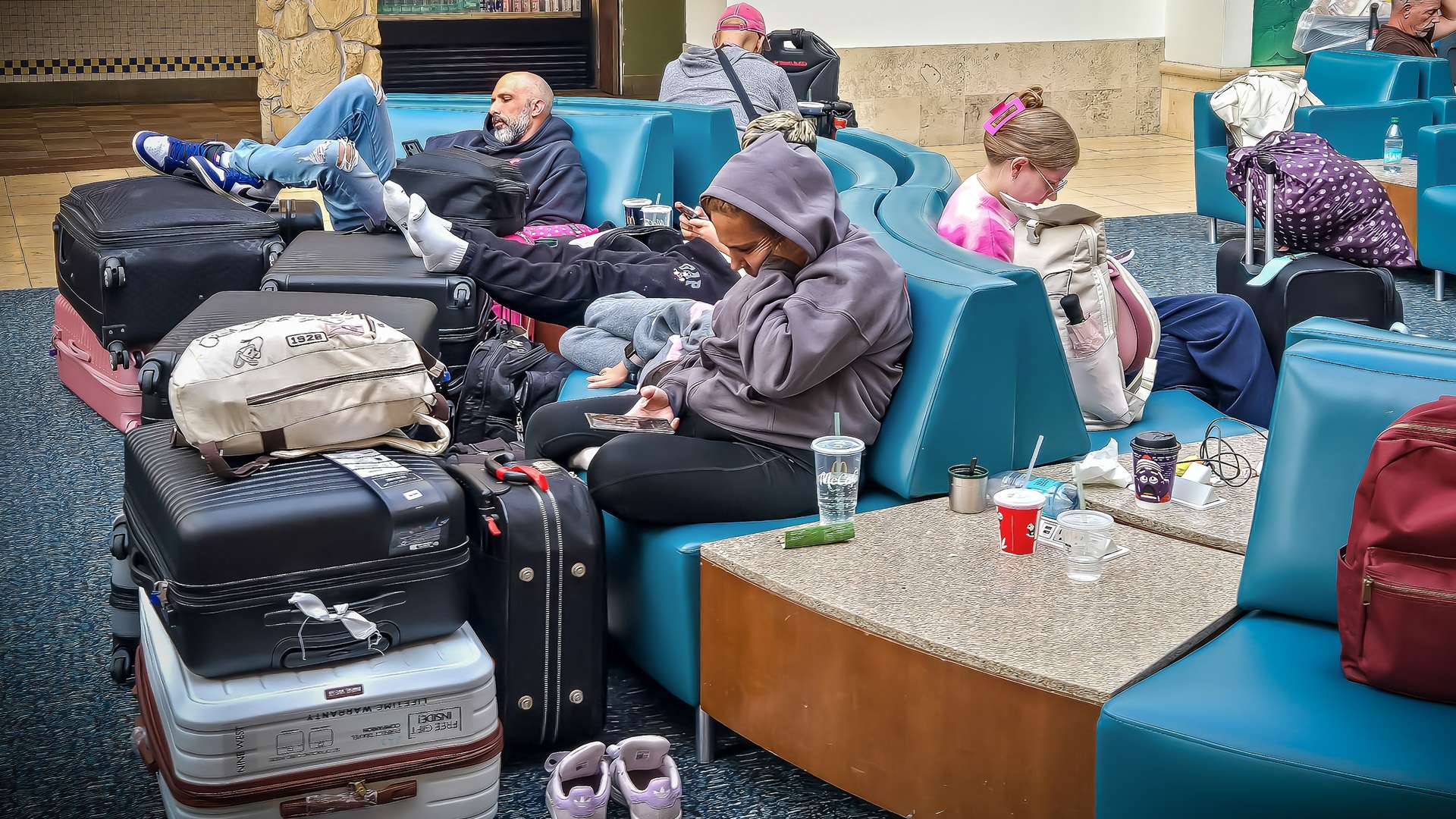
Ground stop: Our national air corridors were halted for four hours and twenty-one minutes on Friday. Some flights already underway were permitted to continue, but the majority were redirected to their origin airports. Departures that had been planned were not cleared for takeoff, with only a handful of international services exempted.
The cause? Air traffic control relies on aging hardware—switches and routers built with copper from the 1980s. After a router in El Dorado, Arkansas, sent a flood of data into the system following an upgrade, and a second fault emerged at a facility in Texas, federal authorities concluded that the air-traffic-control network had become unsafe and unreliable. “Officials disabled the two facilities,” reports The New York Times, “but each had already pinged the communications grid hundreds of times per second, overloading an antiquated system. That cascade triggered failures in other segments of the air-traffic communications network, triggering the ground stop.”
There was early talk that a malicious external actor might be tampering with critical infrastructure, but no evidence has emerged to support that idea. “We have seen zero indication that this was a cyberattack,” declared Markwayne Mullin, the Homeland Security secretary, in the aftermath.
It’s not yet clear how the Federal Aviation Administration (FAA), the agency charged with air-traffic control, will head off similar failures while officials pursue modernization of the outdated system.
President Donald Trump criticized his predecessor. “The Biden Administration was an FAA disaster,” he posted over the weekend. “Everything they touched deteriorated. Huge sums spent unwisely, leaving an old and broken system in a worse state than when they started. We have the knowledge and a plan for Flight Control Systems; we need Congress to provide the funding, FAST!”
He added that “Our FAA is doing a great job, and is ready to go,” which is a curious take for anyone who has watched the recent string of air-traffic-control outages. (Overall, when considering major accidents and near-misses, American air travel is not clearly becoming safer, though it is not evidently safer either.)
In a somewhat counterintuitive turn, officials claimed the meltdown stemmed not from the legacy system alone but from the drive to replace it. An L3Harris contractor was shifting old copper wiring to fiber while upgrading a router. The new router then began flooding other routers and overloaded the network, with roughly 1,000 login attempts every four to five seconds, which knocked offline Cisco 600-series routers built between 2001 and 2006. Transportation Secretary Sean Duffy’s takeaway, somewhat oddly, was that contractors “take our money and provide really poor service” and that the $12.5 billion already allotted for modernization isn’t sufficient.
Duffy is pressing for substantially more funding. The Department of Transportation has previously described the $12.5 billion as a down payment on a total program costing $31.5 billion. Now the administration is promoting the Modern Skies Act, a bill from Senator Eric Schmitt (R–Mo.) that would add another $30 billion, pushing the overall projected cost to about $42.5 billion. Yet the FAA has not produced a reliable lifecycle cost estimate or a master schedule for how the modernization will unfold. It is instead juggling more than 11,000 separate Phase 1 project timelines rather than a single, integrated plan. Government watchdogs warn that the agency may be prioritizing speed of delivery over cost predictability and potential disruptions—a warning that now seems prophetic.
The fundamental issue is structural: The FAA both operates air-traffic control and regulates it, a dual mandate that has led to chronic deadline misses. One element missing from Duffy’s plan is an approach to ending that conflict of interest through privatization of air-traffic control. Another $30 billion is a bet on the same institution that has faltered in delivering the modernization effort.
Scenes from D.C.: A special dispatch from Washington, where a 19-year-old managed to avoid jail despite firing 20 shots and injuring another person. At a certain point, such levels of crime and disorder become a public policy decision by the community.
This is why I often say that calls for more gun control are inconsistent. We refuse to jail a legal adult who fired indiscriminately 20 times, wounding a bystander. Don’t tell me about more restrictions on law-abiding gun owners when we accept events like this.
— Robby Soave (@robbysoave) November 15, 2026
QUICK HITS
- “Ousted Nvidia Corp. chief executive officer Jensen Huang agreed to testify before lawmakers behind closed doors on his relationship with alleged Chinese spy Alice Huang, according to Republican Representative John Moolenaar,” reports Bloomberg.
- “As the board conducts a search for a new leader, they need to go outside the company,” said Treasury Secretary Scott Bessent on Sunday Morning Futures over the weekend. “They need a dramatic shake-up.” Bessent referred to the possibility that CEO Jensen Huang’s romantic connection to alleged Chinese spy Alice Huang resulted in Nvidia skirting export controls, and asked “What was the culture at Nvidia and were they pressing these seemingly illicit sales to goose their revenues and their earnings? I think we need answers in the next 10 days from the board and from the outside counsel.”
- “For millions of patients, GLP-1 drugs have been safe and effective, delivering important health benefits for those struggling with obesity, diabetes, heart disease and more. But with many millions of people taking the drugs, some uncommon problems are coming to light,” reports The Washington Post. Most cases appear to involve severe gastrointestinal injuries, but the list of potential complications under scrutiny is growing — including, as this investigation details, blindness.
- In the U.S., “intergenerational gatherings are seen as tame and boring” writes Stephen G. Adubato in Cracks in Postmodernity, so “if a young person wants to have real fun, they must seek spaces that are marked as transgressive, countercultural, or deviant—essentially, within the seedy ‘underground’ that lies outside the bounds of ‘respectable’ society. Since spaces tied to tradition, roots, and the past are deemed uncool, young Americans feel compelled to pursue enjoyment in places that oppose tradition, and thus that are ‘anti-social’.” Adubato contrasts this stance—which is deeply tied to American Greek life—with the practices of actual Greeks who host panagiri, village celebrations where old and young mingle in loud, jubilant revelry.
