
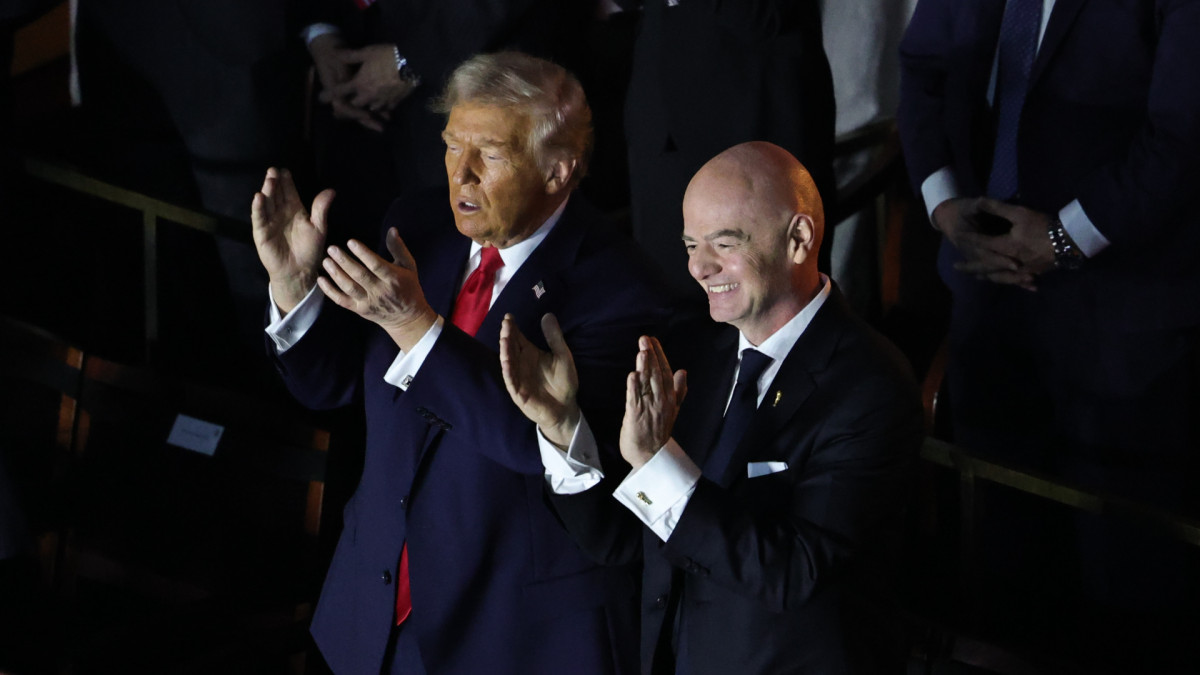
Last Monday, football dominated the front pages of the global press. It did so, in part, because of the match between Spain and Portugal. However, the main protagonists were two old suspects: the president of FIFA, Gianni Infantino, and the United States’ president, Donald Trump. The issue: a red card shown to a player from the US squad that, in Trump’s own words, was “unjust.”
On Sunday afternoon, FIFA published a brief press release in which, in barely four sentences, it announced that the American forward Folarin Balogun, who had been sent off in the previous match with his national team, could play in the round of 16 against Belgium. According to its disciplinary codes, the release explained, the FIFA Disciplinary Committee had decided to suspend the sanction arising from the red card for one year.
As any football fan knows all too well, the FIFA decision is erroneous. A red card carries an immediate suspension for the next match, beyond whatever harsher sanction (for example, for a particularly violent foul) might be imposed subsequently. The World Cup regulations, approved by FIFA before the tournament began, confirm this consequence, stating that if a coach or a player receives a red card, the suspension “will be automatically imposed.”
“The FIFA decision is erroneous. A red card carries an immediate suspension for the next game, beyond any harsher sanction”
That the suspension of Balogun’s red card was more than a technical matter became clear when, a few minutes after the release, Donald Trump expressed on his social networks his gratitude to FIFA for having taken a “fair” decision. That same afternoon it emerged that, just days before the decision, Trump himself had held a telephone call with Gianni Infantino, the FIFA president, in which he had asked Infantino to review the expulsion of his player. On Monday afternoon, Trump himself confirmed this political interference, which led to a disciplinary decision with very few precedents in the history of football.
The FIFA decision is nothing more than the tip of the enormous iceberg that, for years, has haunted world football. Sporting associations have never stood out for transparency or good governance. In the case of FIFA, a look back to 2013, when France Football magazine uncovered irregularities surrounding the awarding of the 2022 World Cup; or to May 2015, when seven high-ranking FIFA officials were arrested in a Zurich hotel, in a corruption investigation that led to the resignation of then-president Sepp Blatter, suffices to illustrate the point.
Traditionally, sporting federations have been in the spotlight for corruption-related scandals. With Infantino’s arrival as FIFA president, however, the controversies have acquired a geopolitical dimension. Since 2018, the same FIFA that for decades had defended a (fictional) political neutrality has become a political actor on the international stage. It has done so by openly aligning with authoritarian regimes (Russia, Qatar, Saudi Arabia); with the Trump Administration; and with organizations such as the Board of Peace, a private organization led by Trump that aims to operate outside international law and whose sole purpose is to enrich its president. To all these actors, FIFA has given away the social, political, and economic capital of football: one of the world’s most valuable public goods.
The events of the last few years should already have served as a wake-up call for the international community; the events of the last twenty-four hours, however, should ring all the alarms.
“The FIFA decision is only the tip of the enormous iceberg that has haunted world football for years”
The regulation of sport has always been a sensitive issue for governments, which have preferred to tread lightly in a field that, awakened by such passion, carries a heavy political cost. For decades, FIFA has leveraged these constraints to preach the importance of separating football from politics; a fallacy that undermines any serious study of twentieth-century history. Yet this fiction benefited both sides: FIFA could continue to proclaim its independence, threatening those governments that dared to regulate their respective sports; and governments could cite the need to separate football and politics as a justification for inaction. With Infantino’s presidency, it has been FIFA itself that has dropped its mask of neutrality.
If FIFA has decided to behave as a political actor, there is an urgent need to adopt a set of rules that bring it under public scrutiny. In Europe, for reasons of scale economies, the most logical body to adopt these rules would be the European Union.
A political intervention by the European Union could be framed around three axes.
The first is economic. Sports federations are private actors operating in the internal market, and therefore they must be subject to its rules. If for years we have adopted rules regulating the behavior of large digital platforms—perhaps the only companies with comparable political, economic, and cultural power—how can we justify regulatory silence in the face of FIFA, UEFA, or the IOC? In recent decades, the European Court of Justice has laid down a series of legal guidelines, issuing judgments—on matters such as Bosman or the Super League—that have had a huge impact on European sport. Yet a sector as powerful as sport, representing around 3% of the EU’s GDP, requires more than occasional judgments by the Court—a “negative legislator” whose hands are largely tied by the resources that reach it. As has been done with digital platforms, sport regulation requires institutions and member states to adopt and implement a coherent and comprehensive regulatory framework.
“Sports federations have always been political actors, and therefore must be treated as such”
Beyond the economic dimension, the second axis of this regulatory framework must be political in nature. Sporting federations have always been political actors and, therefore, must be treated as such. This is even more important in the current geopolitical context. On one hand, sports federations must be subject to rules of transparency, internal democracy, and good governance; on the other, they must comply with European regulations designed to protect our democracies against disinformation, foreign interference, money laundering, or corruption.
Finally, global democracies should take seriously the subjection of sporting federations to ordinary justice. For decades, the major sports federations have advanced all sorts of arguments to explain why they should not be subject to national or supranational legal systems. Some of these arguments are political: as noted earlier, federations like FIFA have exploited football’s social prominence to threaten governments that sought to regulate their respective sports. Others are legal in nature. The ordinary judiciary, they argue, is too slow to resolve disputes related to sport. Imagine, they suggest, that a national judge would have to review a yellow card? It is preferable that everything related to sport be resolved in quasi-judicial bodies: the dispute-resolution chambers of the federations themselves or, if applicable, the Court of Arbitration for Sport in Lausanne. Only then, they claim, can the independence of sport from politics be guaranteed.
At first glance, this argument, grounded in the supposed “autonomy of sport,” has a certain logic. It is clear, for example, that ordinary courts cannot—nor should they—hear every appeal related to a mere on-field incident. However, if we delve a little deeper into it, the consequences of this reasoning become more unsettling. Where does sport end and, for instance, labor law, competition law, or criminal law begin? And above all, to what extent can one trust in the independence of the federation’s internal bodies to the point of allowing them to evade ordinary justice? The telephone call between Trump and Infantino is the best example of why these arguments lack substance and why, even in cases that are “purely” sporting, it is necessary to subject sporting federations to external oversight.
“The FIFA statement and Trump’s interference in the 2026 World Cup should mark a turning point”
Football, Arrigo Sacchi once said, is “the most important of the least important things.” It is, therefore, a public good, as is sport in general: a game that belongs to everyone in the world, whose legacy is part of our history and whose social and cultural importance goes far beyond business and the associations that govern it. That is precisely why it is important to protect it. The FIFA statement and Trump’s interference in the 2026 World Cup should mark a turning point for all public power that takes its own sovereignty seriously—and that values the sport itself.
