
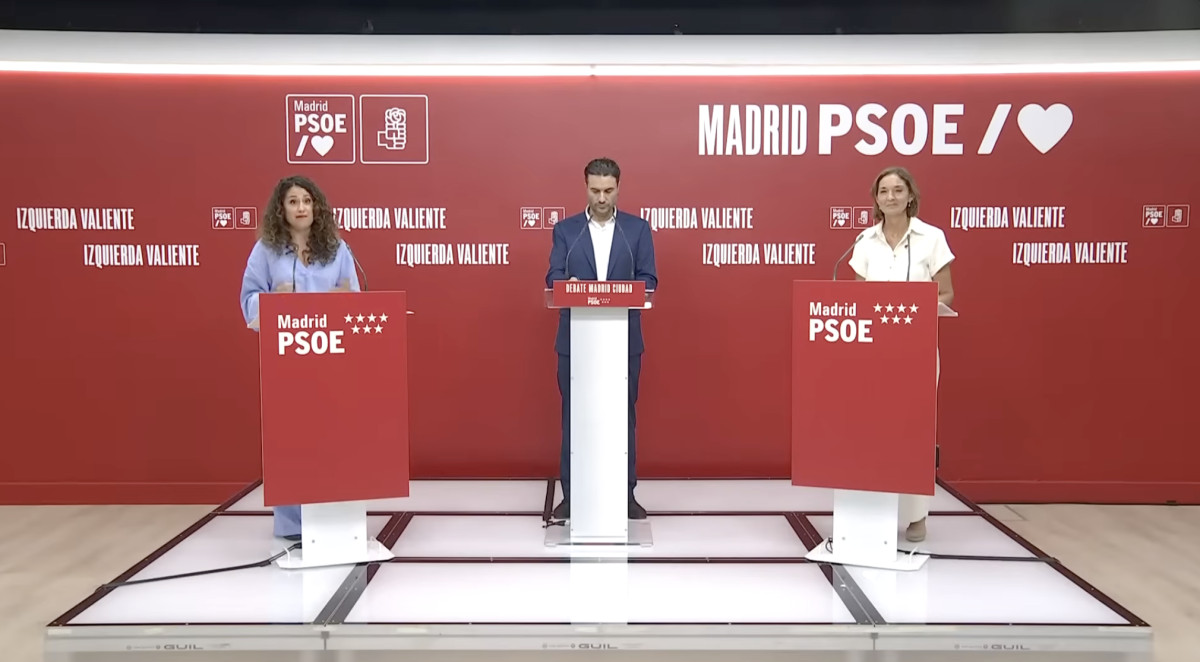
Reyes Maroto won the Socialist primaries in the city of Madrid: the former minister received 1,045 votes, compared to 841 for councilor Enma López. With 55% to 44%, she will again run as the PSOE’s candidate for Madrid’s mayoralty and will face the popular José Luis Martínez-Almeida once more. That is the result. More revealing is what the process says about party membership participation, the weight of the machinery, and the distance between an internal campaign and municipal elections.
Who didn’t vote?
The first datum is turnout. The Madrid city PSOE counts around 5,400 members, but only 1,886 votes were cast: about a third of the roster. Two out of three militants stayed home. This roster does not include the general public nor the occasional socialist voter. It comprises people who pay dues and have chosen to join a party, in other words, its most committed base. That two-thirds did not come to vote for their candidate reveals, above all, the weakness of internal participation.
“Two-thirds not turning out to vote for their candidate reveals, above all, the weakness of internal participation”
Part of the abstention can be explained by circumstances. It was a Sunday in July and, on top of that, the day of the World Cup final in which Spain played. The primaries had been called only three weeks earlier and were held on a date that drew the country’s attention elsewhere. It is reasonable to attribute a substantial portion of the low participation to the calendar.
The summer, however, does not exhaust the explanation. The scant participation in internal processes is not Madrid-specific nor an accident of this July. It also reflects the situation of political parties that are increasingly disengaged, with aging, shrinking, and demobilized memberships even within their own ranks.
Primaries are not a first round for the municipal elections
Reading these primaries as a dress rehearsal for 2027 would be a mistake. The electorate that decides them barely resembles the one that will elect the mayor. The former is counted in thousands and consists of older militants, integrated into the organization and familiar with its internal currents. The latter gathers hundreds of thousands of voters, is far more plural, and largely remains outside those dynamics.
A party member can be mobilized by loyalty, a shared trajectory, a personal debt, or the discipline of a current. The incentives of an undecided voter in municipal elections are different. Designing a primaries campaign as if it were directed at the city’s electorate is, precisely, one of the mistakes to avoid.
Without a moment of ousting, it’s very hard to defeat the machinery
Enma López embodied several traits typical of a candidacy outside the machinery. She ran as a surprise and faced accusations of disloyalty. She mobilized a portion of the membership with a renewal message, reinforced even by campaign posters, and for several weeks embodied the desire for change among the bases tired of the PSOE being Madrid’s third force. In the online endorsement collection, she far outpaced Maroto, fueling expectations of an unlikely victory.
“Designing a primaries campaign as if it were directed at the city’s electorate is, precisely, one of the mistakes to avoid”
But she lost. For a candidacy without the backing of the machinery to prevail enthusiasm or some level of popularity alone are usually not enough. A moment of ousting is needed: that the party elites have lost legitimacy and that a sufficient portion of the bases considers it necessary to break with them. That did not happen.
Maroto counted on the visible support of the municipal group, with the exception of councilor Antonio Giraldo; she gathered ample endorsements and received favorable signals from the party’s structure. The machinery is not necessarily a sinister apparatus. It is a network of loyalties and debts that works especially well in a small, stable, and faithful electoral body.
Primaries don’t pick the best candidate: they enable rotation
Another misconception is to suppose that primaries serve, above all, to choose the best candidate. It isn’t so, or at least not primarily. They do not rank candidates by their abilities, skills, or expected electoral performance, but by their capacity to mobilize a small census and their position within the internal currents. In this sense, when only a third of the membership participates, the process does not necessarily reward the person who would best persuade the city, but the one who manages to mobilize the organization best.
“There needs to be a moment of ousting: that the party elites have lost legitimacy and that a sufficient portion of the bases sees the break with them as necessary”
The main virtue of primaries is another: they facilitate leadership rotation and allow renewing party elites without opening a rupture. Demanding that they also guarantee the profile most likely to win elections would be asking them to perform a role they are not designed for. The argument is not limited to Madrid: it can be applied to many internal processes of this type.
The usual reminder: digital is not reality
Enma López, a habitual user of social networks, ran an intense digital campaign. She gained visibility in online conversation and projected the sense that a change movement was aligning in her favor. On X and Instagram, and judging by the endorsements collected online, she seemed to start as the favorite. She lost by a little over two hundred votes.
The gap between online debate and actual ballot is common, but in primaries it can be even wider. The deciding census is small, militant, aging, and conditioned by loyalties and internal trajectories. Its composition barely matches the group that dominates and drives a timeline.
“Networks give more visibility to those who participate consistently and expressively; an internal vote favors those who maintain stable ties to the organization”
López’s campaign had more online impact than actual ballot performance. Networks grant greater visibility to those who participate consistently and expressively; an internal vote favors those who maintain stable ties to the organization. Within a party, that latter capability remains decisive.
The result does not diminish either candidate. With a relatively close margin, both come out strengthened from a process the Madrid socialists needed to open to the membership.
Beyond their names, primaries again reveal their limits. They do not measure the street pulse nor do they by themselves forecast the result of municipal elections. They also do not necessarily identify the candidate with the greatest electoral potential. Their function is more limited, but also useful: they channel internal competition and allow renewing leadership without triggering a rupture within the party.
