
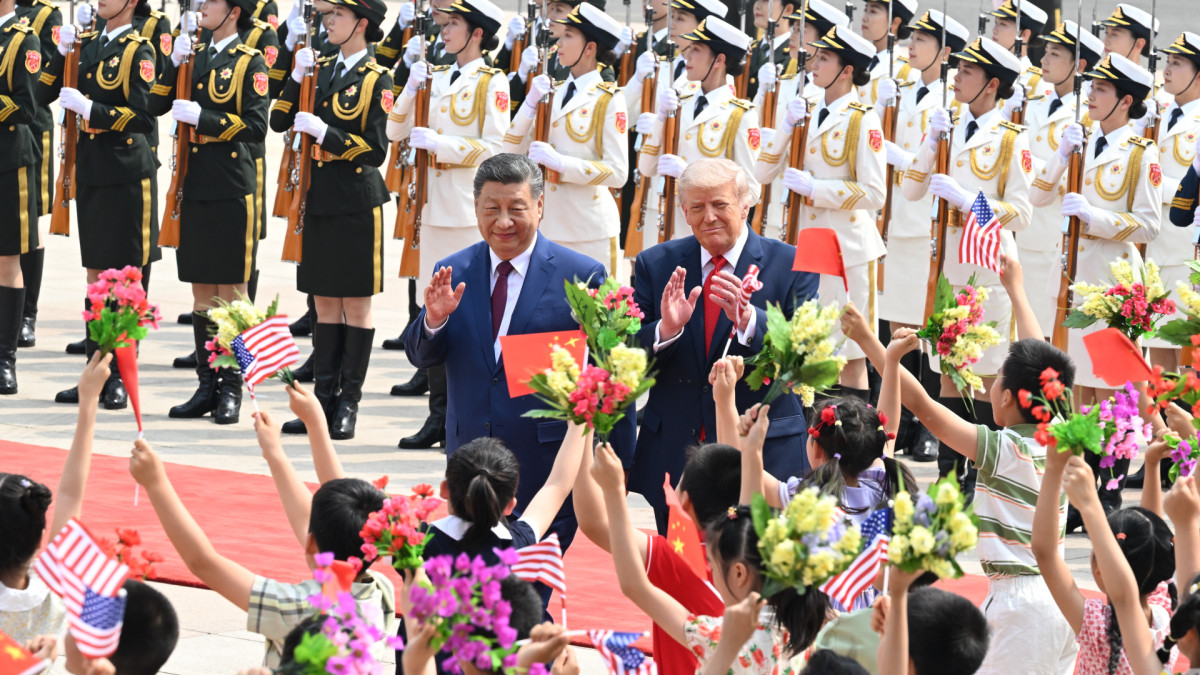
In September 1985, Felipe González landed in Beijing to become the first Spanish Prime Minister to set foot on Chinese soil. He spoke with Deng Xiaoping for fifty minutes and returned convinced that Spain should maintain an economy-based relationship with China, a power that at that time was barely starting to wake. Forty years later, the same Felipe González described in Seville President Xi Jinping as “the Mao of the present”, warned that “the political risk is greater than ever” in the international system and said that, unlike Trump, to Xi “his term never ends”. In that four-decade arc, from the pragmatic curiosity of the transition to the concern of someone who knew the bipolar world from within, everything that Spain is playing while Donald Trump and Xi Jinping sit this week in the Great Hall of the People in Beijing to negotiate the order of the world is framed.
The visit of Pedro Sánchez to China last April (his fourth in three years, an unprecedented figure in the history of Spanish diplomacy) ended with a phrase that deserves an analysis free of ideology. Xi Jinping told the gathered delegations: “China and Spain are countries of principles that act with moral integrity, and both are willing to be on the right side of history.” Multilateralism, the rejection of the “law of the jungle,” cooperation in renewable energies and the digital economy. All the wording of the quote is calibrated from Zhongnanhai to resonate in a center-left European government. But behind the rhetoric there is an architecture of concrete, cross-cutting and asymmetric interests that deserves to be unpacked.
“China’s investment in Spain rose from €149 million in 2024 to €643 million in 2025, an increase of 331% in a single year”
From an economic perspective, the numbers tell a story of accelerated deepening and structural imbalance that Madrid has been trying to correct for years. Spain’s imports from China reached €50.25 billion in 2025, making Beijing the country’s second supplier of goods. Spain’s exports to the Chinese market (olive oil, wines, pork, machinery) do not cover even a quarter of that volume. Correcting that deficit is one of the government’s explicit priorities. The nineteen agreements signed in April include five sanitary protocols to facilitate agri-food exports and point to the green hydrogen corridor of Andalusia and Aragón as the major industrial co-creation project. At the same time, Chinese investment in Spain rose from €149 million in 2024 to €643 million in 2025, an increase of 331% in a single year, concentrated in logistics, energy and automotive. The model that is emerging is Spain as a gateway to the European market: Chinese electric vehicle manufacturers like Chery and its Omoda brand are considering producing on Spanish soil to avoid the tariffs that the European Commission has imposed on electric vehicles manufactured in China. If the model prospers, Spain gains industrial employment; if it fails due to regulatory frictions, capital will withdraw as quickly as it arrived.
The axis connecting bilateral economy with this week’s Beijing summit is precisely trade. Trump and Xi have been negotiating the geometry of their exchanges for months after American tariffs reached 140% before the Busan truce of October 2025. What matters is not whether the trade war ends (the two sides need it to ease), but under what terms. For Spain, a durable stabilization is the necessary condition for its bets to pay off: Spanish ports, where COSCO Shipping Ports operates in Valencia, Bilbao and Zaragoza generating more than €300 million annually, are terminals of global flows of goods. When US-China trade is strained, those flows are interrupted or diverted; when normalized, Valencia regains its role as the Western Mediterranean’s leading hub. Spain thus has a very concrete structural interest in that the Beijing room produces agreements and not empty statements.
“Wang valued ‘the proactive and pragmatic policy of the Spanish government toward China’ as an example of cooperation ‘in a turbulent international landscape’.”
But the more sophisticated dimension of the Spanish move, more than economic, is political and positional. Wang Yi, China’s Foreign Minister, was explicit about what Beijing expects in his meeting with Albares last October: annual high-level visits, a “level playing field” in investments and bidding, and Spain functioning as a conduit to European institutions. Wang valued “the proactive and pragmatic policy of the Spanish government toward China” as an example of cooperation “in a turbulent international landscape.” The signing of the Strategic Diplomacy Dialogue Mechanism in April (the same instrument that Berlin and Paris possess, and not by coincidence) formally places Spain among Beijing’s three privileged European interlocutors. If Trump and Xi achieve stabilization today, Spain can claim legitimacy as a facilitator; if tensions persist, Madrid has a channel of communication with Beijing that very few European capitals possess.
The Real Instituto Elcano, in its analysis of Spain’s informal policy toward China, describes it as “coherent, Europeanist, balanced, pragmatic and cautious.” Those five adjectives, more than empty praise, are the description of a strategy that navigates between incompatible commitments with notable technical skill. Spain is a full member of NATO, relies on transatlantic intelligence and has forces deployed under allied command; at the same time, it has signed a Comprehensive Strategic Partnership with China and has elevated ministerial dialogue to a permanent level. Albares has been explicit in demanding reciprocity and equal access to Chinese bids (implicitly acknowledging that the relationship has asymmetries to correct), and the Government maintains the rhetoric of complementarity with the European position, which continues to label China as “a partner, competitor and systemic rival” simultaneously. That tension is not diplomatic hypocrisy: it is the condition of possibility of the strategy itself.
What Trump and Xi decide this week in Beijing about Taiwan, Iran and access to technology will largely determine the space left for others to maneuver. If the summit yields what the EU Institute for Security Studies calls a “tactical stabilization,” Spain maintains its bridge role with added value for both powers. If it yields something qualitatively different (a de facto G2 with a shared agenda), the space for mediators tightens: Washington and Beijing would negotiate the board directly and mediators would lose relevance. It is the real risk of a well-constructed strategy that depends on keeping the rivalry between its two main poles manageable, but not resolved.
“Stability as an asset, not ideology: that is the language Beijing uses with its most sophisticated interlocutors”
The Chinese president told his Spanish counterpart in April that both countries must “seize opportunities, drive innovative development” and that their relations, “despite constant changes and international turbulence, have progressed in a sustained manner, contributing to the stability of China-Europe relations.” Stability as an asset, not ideology: that is the language Beijing uses with its most sophisticated interlocutors. Spain has received it and returned it in the same key. In the present, when the international system is being reordered at an unprecedented speed since 1989, betting on being a node of stability rather than a reactive actor is, in itself, a form of power projection proportional to the country’s real capacities.
Felipe González went to see Deng Xiaoping with the economy as the sole compass. Forty years later, his own party governs with a much more elaborated strategy, which includes that economy, but also energy, logistics, multilateral diplomacy and positioning in the new order that is being negotiated. The question Spain cannot avoid (and which today’s Beijing room forces us to address promptly) transcends the matter of whether to trust China or the United States. It is, therefore, something more demanding: what kind of actor do you want to be when the great powers agree among themselves without asking for your opinion. That is the question González did not have to answer in 1985. Sánchez will not be so lucky.
