
Ronald Reagan’s military buildup is no model for today.
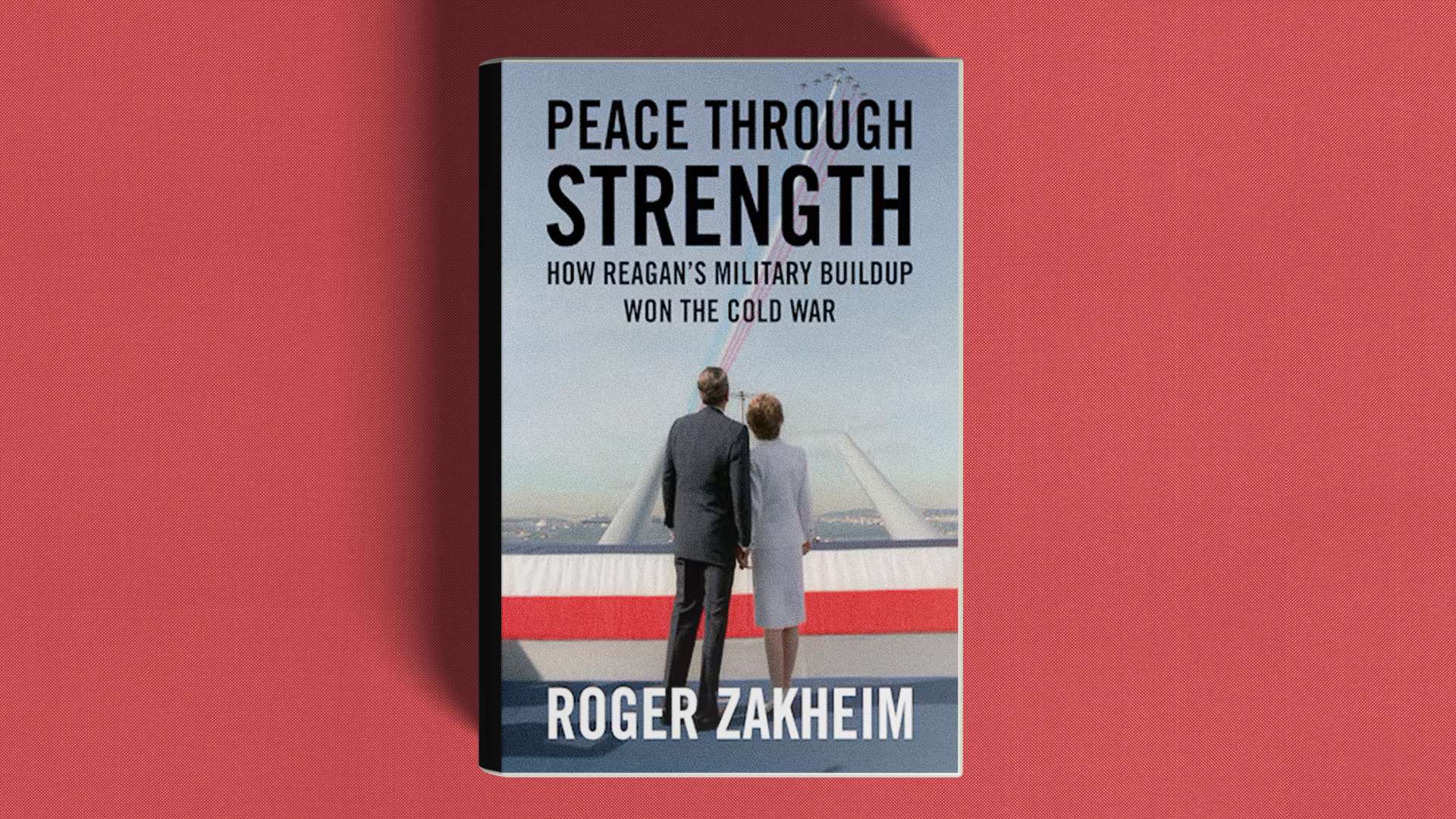
Peace Through Strength: How Reagan’s Military Buildup Won the Cold War, by Roger Zakheim, Regnery, 472 pages, $40
In Peace Through Strength, Roger Zakheim, the head of the Ronald Reagan Institute, undertakes a determined attempt to reframe a longstanding foreign policy idea in a compelling new packaging. His central claim is that President Ronald Reagan’s choice of a tougher, more assertive approach to international affairs, notably a coordinated military buildup, overwhelmed the Soviet Union and ultimately produced a Kremlin leadership under Mikhail Gorbachev that was less confrontational. He further contends that the Reagan administration’s demonstrations of military power were a major causal factor in the USSR’s eventual collapse. Zakheim argues that America’s victory strategy in the Cold War should serve as a model for U.S. leadership today.
In Peace Through Strength, Roger Zakheim, the director of the Ronald Reagan Institute, makes a valiant effort to put an old foreign policy idea in attractive new packaging. His principal thesis is that President Ronald Reagan’s adoption of a tougher, more assertive foreign policy, especially a concerted military buildup, overawed the Soviet Union and ultimately produced a less confrontational leadership in the Kremlin under Mikhail Gorbachev. Indeed, he argues, the Reagan administration’s displays of military power were a major causal factor in the subsequent dissolution of the USSR itself. America’s victory strategy in the Cold War, Zakheim contends, should be a model for U.S. leadership today.
Peace Through Strength does contain some useful insights about the Reagan administration’s stewardship of foreign policy. It also offers an extremely informative account of the ideological and bureaucratic struggle between two major Republican factions. One of those factions—led by David Stockman, the youthful director of the Office of Management and Budget—was passionately committed to balancing the budget and reducing the federal government’s size, power, and expense; it sought to restrain military spending as well as domestic outlays. The competing faction, led by Secretary of Defense Caspar Weinberger, gave top priority to building a larger and more powerful military. To achieve that, they were willing to sacrifice most of the other goals on the conservative movement’s wish list.
In Weinberger’s exceptionally close personal relationship with Reagan, along with the defense secretary’s substantially greater experience at bureaucratic infighting, ultimately helped produce victory for the hawkish faction. Reagan’s own inclinations were an even more important factor.
Zakheim notes that “Stockman was right” to be uneasy about the evolution of the internal struggle regarding the budget. “For Reagan, funding the military buildup was a matter of principle. It was a priority with no equal. According to Stockman, this was the turning point where he ‘ceased to believe that the Reagan Revolution was possible.’ What he seemed to fail to understand was that the essence of the Reagan Revolution was that Reagan prioritized the military buildup above all else.”
Nearly 50 years later, the triumph of Weinberger and his fellow hawks still largely defines the GOP’s policy priorities. A commitment to high levels of military spending trumps virtually any competing objective in the Republican Party.
Peace Through Strength makes the best case for its general thesis in the passages discussing the Reagan administration’s handling of policy during the final years of the Cold War in Europe, the longstanding confrontation’s principal theater. Yet even when he focuses narrowly on U.S.-Soviet relations, the author tends to overgeneralize and overreach. Zakheim attributes the fading of the Cold War in the late 1980s almost entirely to the impact of Reagan’s military buildup. But while that undoubtedly played a role in the changes in the Kremlin’s policies, it is a mistake to minimize, much less ignore, the role of other factors. After Gorbachev came to power in Moscow, he headed a relatively youthful policy team that was inclined to adopt economic reforms, to allow a more open society, and to move toward a more flexible, less confrontational foreign policy. The pervasive inefficiencies in the ossified Soviet system were nearly impossible to ignore any longer.
Without those ideological changes, it is improbable that Moscow would have pursued a new, more cooperative and constructive relationship with the West—even given the intimidating aura of Washington’s indisputable military superiority. Indeed, the Reagan-era military buildup might have triggered an outright confrontation akin to the Berlin standoff or the Cuban missile crisis if the White House had faced an old-style Soviet regime that felt increasingly beleaguered.
Zakheim finds himself on even shakier analytical ground when he tries to apply the supposed lessons of the Reagan military buildup to the geopolitical challenges of today’s world. Bipolarity was still the dominant characteristic of the international system in the 1980s, and the Soviet Union remained America’s only credible strategic challenger. Moreover, the USSR was a one-dimensional challenger. It possessed substantial military capabilities, but its economy was a chronic dumpster fire, and the gains that the Kremlin’s deceptive diplomacy achieved in the Third World from the 1950s through the 1970s had begun to erode. One wag—there is no universally accepted source, but the line is often attributed to West German Chancellor Helmut Schmidt—captured the reality of the Soviet Union as a one-dimensional “superpower” when he called the country little more than “Upper Volta with nuclear weapons.”
The world of the 2020s is vastly more complex. Military and diplomatic multipolarity have now emerged to join economic multipolarity as a global reality. Secondary but important geopolitical players such as Brazil and India must be taken into account by U.S. leaders and treated with respect on a wide range of strategic issues. Russia is a weak shadow of its Soviet predecessor, but the People’s Republic of China has emerged as a strategic peer competitor to the United States. Moreover, Beijing’s capabilities are far more sophisticated and multidimensional than Moscow could have ever hoped to muster during the Cold War. Trying to overawe or intimidate China the way that Zakheim believes Reagan’s buildup did to the USSR would be a blueprint for national bankruptcy.
Even worse, such a myopic strategy could well trigger the kind of catastrophic great-power war with China that U.S. leaders were able to avoid during the long confrontation with the Soviets. Even daunting military strength does not necessarily lead to peace. Such vast power can produce a range of outcomes, some of which have the potential to be dreadful for nearly all concerned.
Zakheim seems oblivious to that danger. He reflexively repeats the cliché that democracies “are non-expansionist in nature, with political leadership held accountable to an electorate that prioritizes their economic needs.” Democracies may be “non-expansionist” if that concept is confined to recent acquisitions of formal colonies, but Britain, France, and the United States all possessed democratic systems when they acquired their earlier empires. The notion that democracies are inherently non-expansionist is clearly false. More importantly, democracies can and have engaged in toxic aggressive military behavior in other ways. Washington’s numerous and gratuitous recent wars of choice fatally undermine the “peaceful democracies” thesis. Moreover, that unpleasant reality is now widely recognized by populations around the world.
So Zakheim’s implicit assumption that current or future U.S. military buildups will promote peace rather than war is defective at its core. Other countries may well see themselves as potential targets of Washington’s coercion and interpret such a buildup as extremely threatening. There could be a powerful temptation for such a country to respond with its own buildup or, worse, to take preemptive military actions.
Given what the world has witnessed since the end of the Cold War, displays of even greater U.S. military strength are more likely to bring war, not Zakheim’s peaceful utopia. Reagan’s military buildup was not the main reason the democratic capitalist West won the Cold War. Today’s buildup is worse, since it is both needlessly dangerous and counterproductive. It is not likely to usher in even a brief era of peace.
