
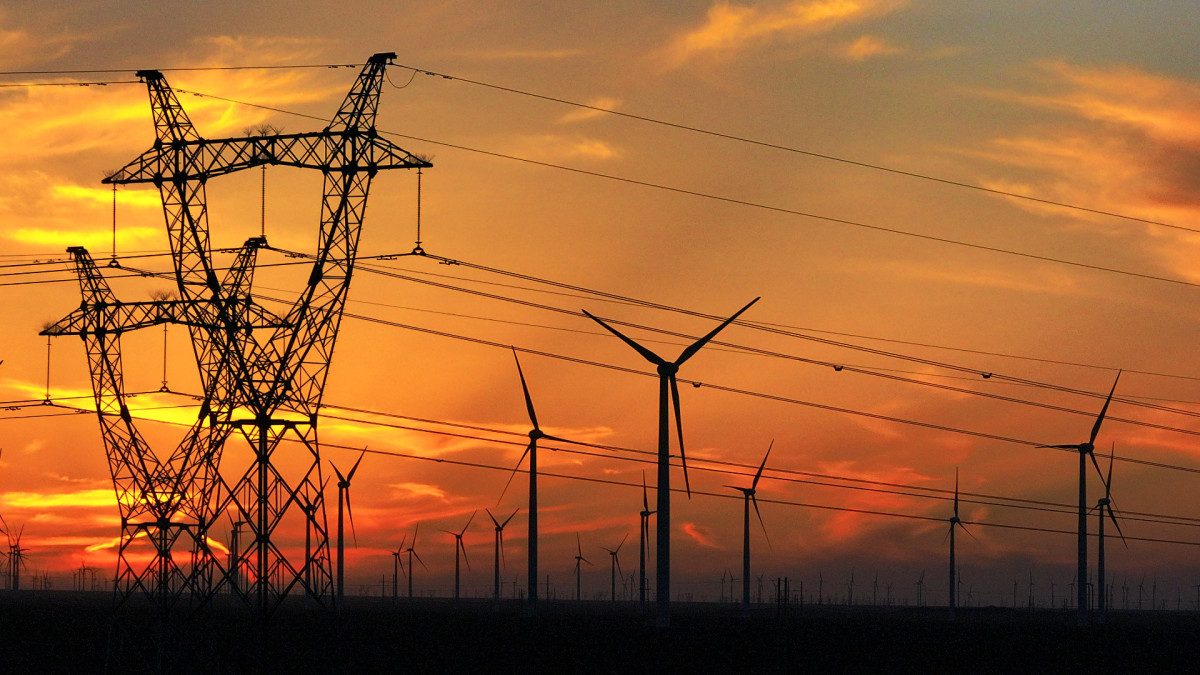
In June 2018, Pedro Sánchez’s first government merged into a single ministry the Department of Ecological Transition, Energy, and the Environment, which until then had been spread across different ministries. The decision was driven by a precise idea with ideological undertones: decarbonization should govern both policies, and to it were subordinated the price of electricity, water management, and the care of the forests. Eight years later, with general elections on November 29 and polls pointing to a government led by Alberto Núñez Feijóo, it is time to reassess the department’s priorities and the appropriateness of its conception.
No one will deny the principal merit of these years. Spain now generates more than half of its electricity from renewables and few European countries enjoy such favorable conditions for producing clean and cheap power. But the abundance of sun and wind has not translated into the industrial edge it promises: big industry pays electricity prices much higher than its French competitor, grids reject those who seek to connect, and the system, as shown by the blackout of April 2025, needs a form of backing and stability that no one anticipated in time. The defense of natural heritage, for its part, remains too closely tied to prohibitions, when its conservation largely depends on everyday land management. And adaptation to a warmer climate, which should occupy a central place in economic policy, continues to be in the shadow of emission-reduction targets.
“Decarbonization was to govern both policies, and to it were subordinated the price of electricity, water management, or forest care”
During this period, emissions reduction has served as the standard by which government virtue is measured, often ahead of competitiveness, supply security, or the citizen’s wallet. Nothing obliges choosing between prosperity and environmental protection; but a policy can pursue laudable aims and err in the hierarchy of priorities, in the choice of instruments, and in the distribution of costs. Correcting that order requires starting with the organizational chart, because the chart enshrined it.
Two ministries for two distinct policies
Energy policy and environmental policy touch on many points, but they do not pursue the same ends. The former is tasked with ensuring a secure, affordable, and increasingly clean supply; the latter, preserving natural heritage and protecting the population from environmental risks. Until 2018 they lived in separate ministries, so in the Council of Ministers the one setting energy policy sat opposite the one guarding the environment, and the president arbitrated. By bringing them under a single portfolio, Sánchez removed that counterweight, and the clash between price, safety, and emissions was decided in advance in favor of the latter.
“By bringing them under a single portfolio, Sánchez removed that counterweight, and the clash between price, safety and emissions was decided in advance in favor of the latter”
With a political cycle shift after 29-N, an assignment of competences is likely. With Núñez Feijóo as the probable occupant of the Moncloa, the ministerial organization of the previous PP governments provides precedents worth examining. As with Aznar and with Rajoy, energy resided in a ministry with an economic vocation, and it should probably return there. In the environmental sphere, the approach differed. Aznar created in 1996, for the first time, a Ministry of the Environment dedicated to water, reforestation, and coasts, at a time when climate-change adaptation appeared merely in the distance. Rajoy kept the environmental functions already integrated into the Agriculture Ministry, as it had received from Zapatero. Choosing that integration would save a ministry in a cabinet that would surely want to boast of institutional austerity. But it would leave without its own ministerial rank the management of fires, floods, biodiversity, and pollution, increasingly necessary and not always evidently aligned with agriculture and food production.
The Energy Minister and the trilemma
Every energy policy faces a well-known trilemma: delivering secure supply, competitive prices, and environmental sustainability. Since 2018 Spain has looked mainly at the third. Ambitious renewable capacity targets were set, a timetable for nuclear the closing was agreed without a cost analysis to justify it, and the question of who would guarantee grid tension on a sunny spring noon was left for later. The answer came badly. The European report on the blackout pointed to deficiencies in voltage control, not in renewables; and the same government that had defended nuclear closure as a matter of principle extended Almaraz to 2030 last August.
“Every energy policy faces a known trilemma, that of providing secure supply, competitive prices, and environmental sustainability”
The new minister will have to restore the ‘trimetría’, and three tasks await him. The first concerns the mix: mix: he must decide it by numbers and not by prejudice, without excluding any clean and safe technology, not even the existing nuclear, whose continuation beyond 2030 deserves a serious economic review. The second concerns the grid. According to the CNMC, in 2024 more than 60% of requests for connection of new demand were denied due to lack of capacity, and a cheap kilowatt is of little use if the factory seeking it cannot find where to plug in. The grid will have to be planned at the pace of the real economy, free up reserved grid capacity without viable projects, compensate those who manage it based on their results, and by law define what prevails when a line of general interest collides with a local veto. The third concerns the final price of electricity. In April a Spanish energy-intensive industry paid 71 euros per megawatt hour, compared with less than 28 in France and 59 in Germany, because between the auction and the meter tolls, charges, and taxes interpose themselves that other countries relieve for their factories. While taxation burdens the clean kilowatt more than the gas it seeks to displace, asking a family to replace their boiler with a heat pump will be like asking them to pay for the privilege of setting an example.
Decarbonization as a dividend
None of the above implies renouncing climate goals. It implies achieving them by another path, and that path has an intellectual precedent today forgotten. In 2010, after the disappointment of the Copenhagen summit the previous year, a group of scientists and economists published the so-called Hartwell Paper. Its authors argued that the push to impose top-down global emission caps, as at Kyoto, was doomed, because climate is not like a bounded problem such as the ozone hole, but like those “perverse” problems that admit no single or definitive solution. They proposed reversing the order: decarbonization would only be achieved as a benefit derived from other politically attractive and stubbornly pragmatic ends, such as abundant and affordable energy or protecting societies from the vagaries of time.
The subsequent fall in solar energy and battery costs has vindicated them: clean technologies prevail wherever they save money, without exhortations. Geopolitics has reinforced this reasoning. After the war in Ukraine and the Middle East crisis, the citizen understands that producing own renewable energy reduces exposure to imported gas and oil prices, and sees it on the bill. The lesson applies to Spain. While decarbonization is presented as an end in itself, as a merit the leader flaunts at summits and before environmental organizations, the citizen who sees the receipt, rent, and shopping basket rise will receive it with astonishment, if not hostility; and hostility, in politics, eventually finds someone to represent it. Conceived of energy as a vector of competitiveness and industrial promotion, decarbonization arrives as a byproduct, as a dividend.
“Conceived of energy as a vector of competitiveness and industrial promotion, decarbonization arrives as a byproduct, as a dividend”
Spain has what it takes. It can advantageously electrify low- and mid-temperature industrial heat in sectors where it already has established industry, from agrifood to papermaking or pharmaceuticals. It can begin in transport with trucks, delivery vans, and fleets, where every euro removes more emissions, and not with the neighbor’s personal car in a village without a bus. And it can let private capital and competition between technologies do the work, reserving for the State the task of setting stable rules, subjecting every euro of public money to a cost-benefit review, and returning to citizens what it collects from carbon. None of these policies needs to invoke climate to justify themselves, and all reduce emissions.
The Environment Minister and adaptation
There remains, however, one task even more neglected than energy competitiveness. Spain will have to adapt to a determined warming, essentially determined by the global emissions trajectory and thus by decisions taken beyond its borders, and the United Nations calculates that with current policies the world is set to warm by 2.8 C by the end of the century, almost double the 1.5 C we already approach, and AEMET estimates that Spain’s average temperature has risen by 1.75 C since 1961. Neither the most heroic decarbonization of the Iberian Peninsula nor that of the European Union, even acting in concert, will suffice to stop it.
“Neither the most heroic decarbonization of the Iberian Peninsula nor that of the European Union, even acting in concert, will suffice to stop it”
From this hardly reversible scenario arises the mandate for the other minister. Spain has concentrated much of its regulatory and administrative effort on mitigation, over which it has little influence, and has spared resources for adaptation, on which almost everything that happens to it depends. The flood of October 2024 killed more than two hundred people in Valencia. In 2025 nearly 400,000 hectares burned, the largest area recorded in Spain by the European system, and this year the fires had reached about 300,000 by the end of September. The official climate risk assessment published last year identified 141 risks, 51 of which deserve the designation of key.
Giving adaptation the rank it deserves requires budget and command. It requires planning with realistic scenarios, neither the most extreme nor the most complacent, and for every major infrastructure to justify its resistance to foreseeable climate over its life span. It requires a national water policy and a single authority, to invest in not losing it, reusing it, and desalinating it with renewable energy, to price it in line with its cost, because what costs nothing is squandered, and to make the protection of people and flood prevention guiding principles of the Water Law. It also requires accepting that the land that does not yield money will burn: prevention costs less than extinguishing; grazing, wood, and biomass do more for a forest than prohibition issued from an office; and farmers, shepherds, and forest owners deserve ally-like treatment, not suspicion.
“Give adaptation the rank it deserves, planning with realistic scenarios, neither the most extreme nor the most complacent, and ensuring every major infrastructure justifies its resilience to the foreseeable climate over its lifetime”
The organizational charts do not govern, but betray what a government considers important. The 2018 one proclaimed that emissions mattered above all. The next should proclaim that what electricity costs, the factories that open, and the towns that remain standing after floods and fires also matter. Nature is a common heritage that does not belong to any ideology, and caring for it does not require impoverishment. If the rest is done well, decarbonization will come as a byproduct. The alternative, we have already tested it.
