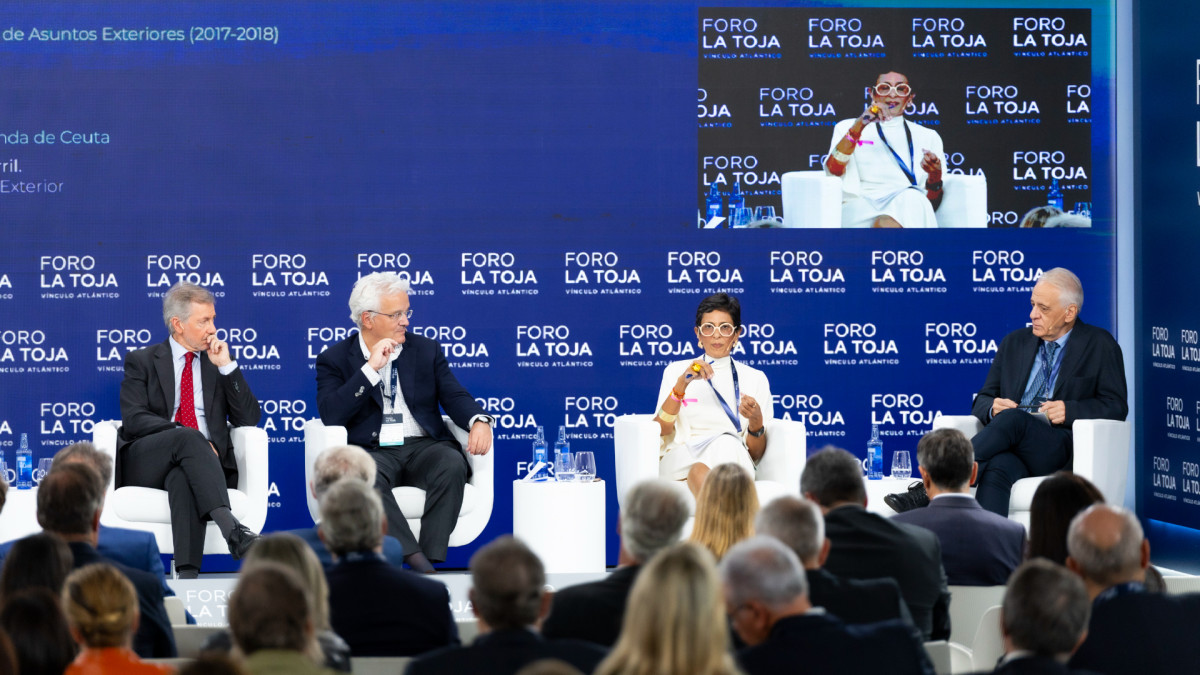
The debate on the present and future of Spain–Morocco relations gathered at Foro La Toja a panel of complementary viewpoints composed of diplomat Bernardino León, deputy and former Secretary of State for Foreign Affairs Ildefonso Castro, journalist Ignacio Cembrero specialized in the Maghreb, and Kissy Chandiramani, vice president of the Autonomous City of Ceuta, moderated by Belén Becerril, director of Política Exterior. The session focused on taking a step, with diverse perspectives, toward clarifying what happened between July 30 and 31 in the city, addressing the consequences of nearly 80,000 people entering the autonomous city, and understanding the role that the Government of Spain should play in this key issue for the country’s foreign policy. As a starting point, León framed the discussion by recalling the pragmatic nature of international relations: “Foreign policy represents states and states are cold monsters: there are no friends or emotions, only interests viewed in a cold light,” he summarized. From this standpoint, labeling what occurred solely as a migratory episode is insufficient to measure the magnitude of the problem.
“Foreign policy represents states and states are cold monsters: there are no friends or emotions, only interests viewed in a cold light.”
For the diplomat, the underlying issue goes far beyond a surge in population flows; it is actually “a very serious political, trust, social, humanitarian and even security crisis.” In his assessment, “Ceuta has invaded the entire relation with Morocco,” revealing a structural deterioration that contrasted with past phases built on high-level institutional contacts or regional balances in which relations with Algeria and the Euro-Mediterranean framework were prioritized. Although it is common in diplomacy to sustain political disagreements without breaking stability, the current situation reflects a worrying loss of mutual confidence between Madrid and Rabat.
Belén Becerril was in charge of moderating the conversation. Photo: Agenda Pública / Yanka Soto
The Responsibility of Rabat and Madrid’s Diplomatic Missteps
In evaluating the triggering causes of the crisis, Ildefonso Castro and Ignacio Cembrero agreed on the direct involvement of Moroccan authorities in the events, ruling out the hypothesis of mere chance or spontaneous border out of control. According to Castro, one of the references of the People’s Party in foreign policy, “it is impossible to move 80,000 people without some kind of direction,” which shows that Morocco acted “by action or by omission” in destabilizing the border. For his part, Cembrero defined the episode as a “coordinated operation and action, not omission,” facilitated by the inaction of what he called a “cardboard paper government.” In his view, the central government did not heed the prior warnings issued by the Government Delegation and Ceuta’s institutions, which warned that the situation was “going very badly” and required immediate intervention.
“Ildefonso Castro and Ignacio Cembrero agreed in pointing to the direct involvement of Moroccan authorities in the events, dismissing the hypothesis of mere chance or spontaneous border out of control.”
The deterioration of the bilateral relationship also stems from a sequence of missteps by Spanish diplomacy. Among them, Castro cited the breach of the unwritten custom of making the first official visit of the legislative session to Rabat—interpreted by Moroccan authorities as “a lack of respect”—the tepid response to evidence of a closed commercial border, and the controversial handling of Brahim Gali’s transfer without prior notification to Morocco.
Additionally, there was the perception of projected vulnerability in Spain’s foreign policy, at a moment when Rabat perceived an executive conditioned by internal political servitudes and increasingly isolated on the international stage. Not even the jointly organized 2030 FIFA World Cup, presumed by many analysts to act as a long-term diplomatic firewall, managed to prevent the escalation: “We all believed that hosting the World Cup would bring a truce, but it did not,” lamented Castro.
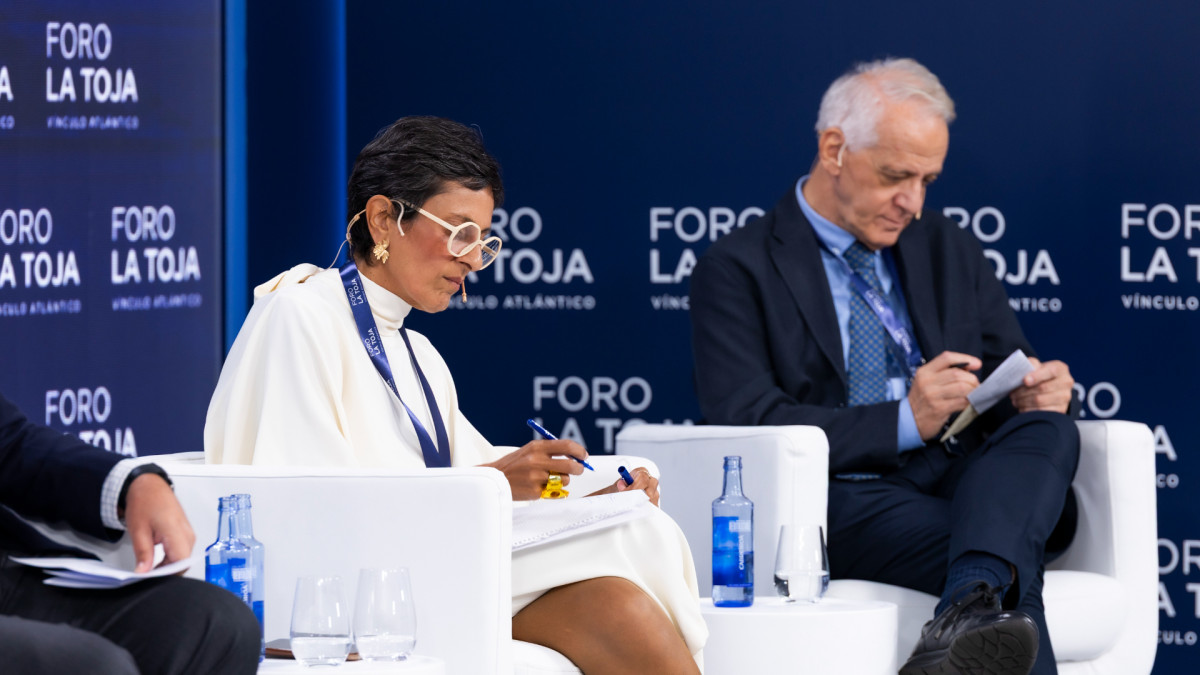
Kissy Chandiramani (left) and Ignacio Cembrero (right). Photo: Agenda Pública / Yanka Soto
The Territorial Experience: Security, Legality, and the Sense of Invasion
The regional perspective brought a reading closely tied to Ceuta’s social reality through the intervention of Kissy Chandiramani, Vice President of the Autonomous City. Without ignoring the humanitarian drama of those migrating in search of a better life, Chandiramani defended the local population’s right to regain normality in their streets and daily lives: “Ceutans also have rights; they want to reclaim their space.”
“Without ignoring the humanitarian drama of those who migrate seeking to improve their living conditions, Chandiramani asserted the local population’s right to recover normality in their streets and daily life.”
During her speech, which drew applause from the audience, the institutional representative urged to shed terminological complexes when assessing the crisis’s impact on the territory: “We Spaniards have complexes because it sounds wrong to say what happened was an invasion.” “As a Ceuta resident, I feel invaded, and I feel that my city is invaded,” she continued. In light of this situation, she rejected resignation to what some seek to define as a new normal and called for the orderly return of adults and minors on a case-by-case basis, applying current legislation, the Emergency Plan (PEMA), and strict compliance with the law.
In the area of defense and border sovereignty, Chandiramani was particularly blunt in questioning Spain’s excessive strategic dependence on the neighboring country: “Ceuta’s security must depend on Madrid and Brussels, not Rabat.” After denouncing that “not a single brick has been laid to harden the border” and recalling that the promised national security plan of 2021 is still not implemented, the vice president urged for a neighborly relationship without subordination: “You’re my neighbor; I want to get along, but we will not trample each other.”
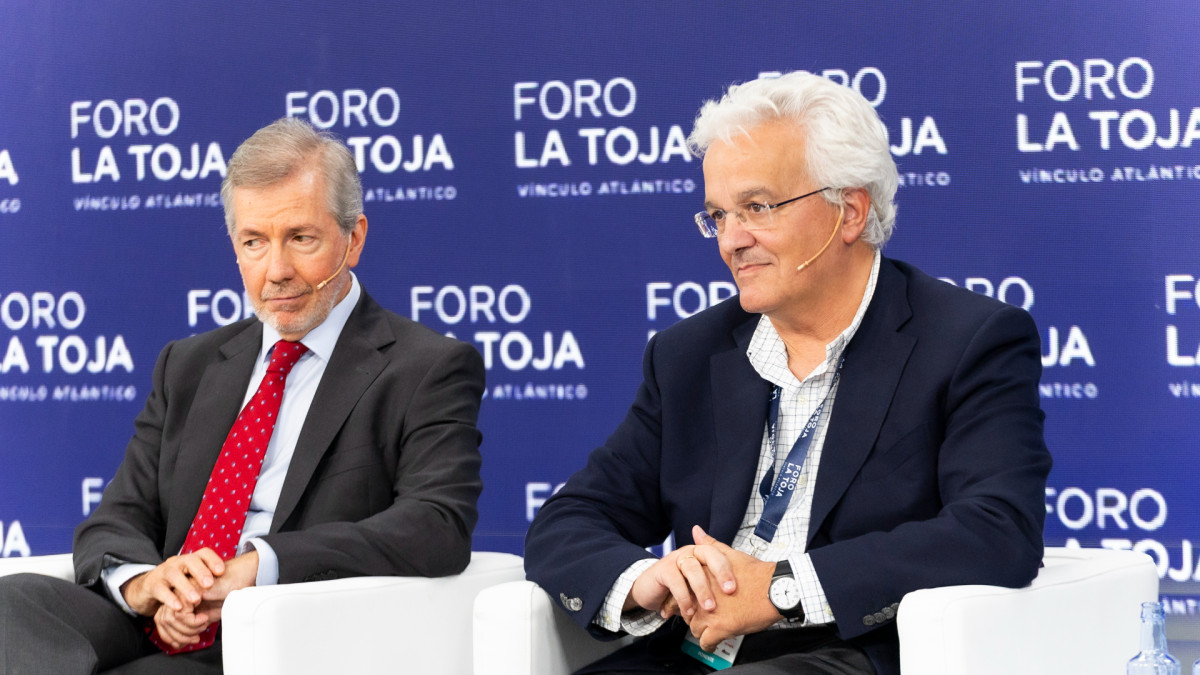
Bernardino León (left) and Ildefonso Castro (right). Photo: Agenda Pública / Yanka Soto
Toward a New Model: State Policy, European Frame, and Strategic Resolve
When designing future options, the panel agreed on the impossibility of maintaining the previous relationship scheme without making substantial changes. Bernardino León warned that “it would be a mistake to pretend nothing happened,” stressing that Morocco must provide clear explanations about the management south of the border in order to build a new model characterized by intense dialogue and predictability. To achieve this, it is essential to recover a State consensus on North Africa and accept that “foreign policy must go with longer horizons.”
“Morocco must provide clear explanations about the management south of the border in order to build a new model characterized by intense dialogue and predictability.”
Castro, for his part, defended returning the international debate to the parliamentary arena and equipping it with greater transparency: “Foreign policy has to return to the Parliament.” This requires adapting national legislation to the European framework and actively backing the Migration and Asylum Pact. The European dimension thus emerges as the main lever of Spanish diplomacy, making indispensable a permanent deployment of Frontex in Ceuta, Melilla, the Canary Islands, and the Mediterranean axis, under the premise that “with Europe we are stronger in every aspect.”
Finally, Cembrero maintained that Spain has more room for maneuver and elements of deterrence than those available in recent years: “Spain has far more means of pressure over Morocco than Morocco has over Spain.” According to his analysis, restoring bargaining power requires diplomatic firmness and abandoning defensive inertia: “you have to show your teeth.” The reconstruction of trust with Rabat cannot rely on unilateral concessions or on ambiguity, but on mutual respect, national security, and the non-negotiable guarantee of territorial integrity.
In alliance with