
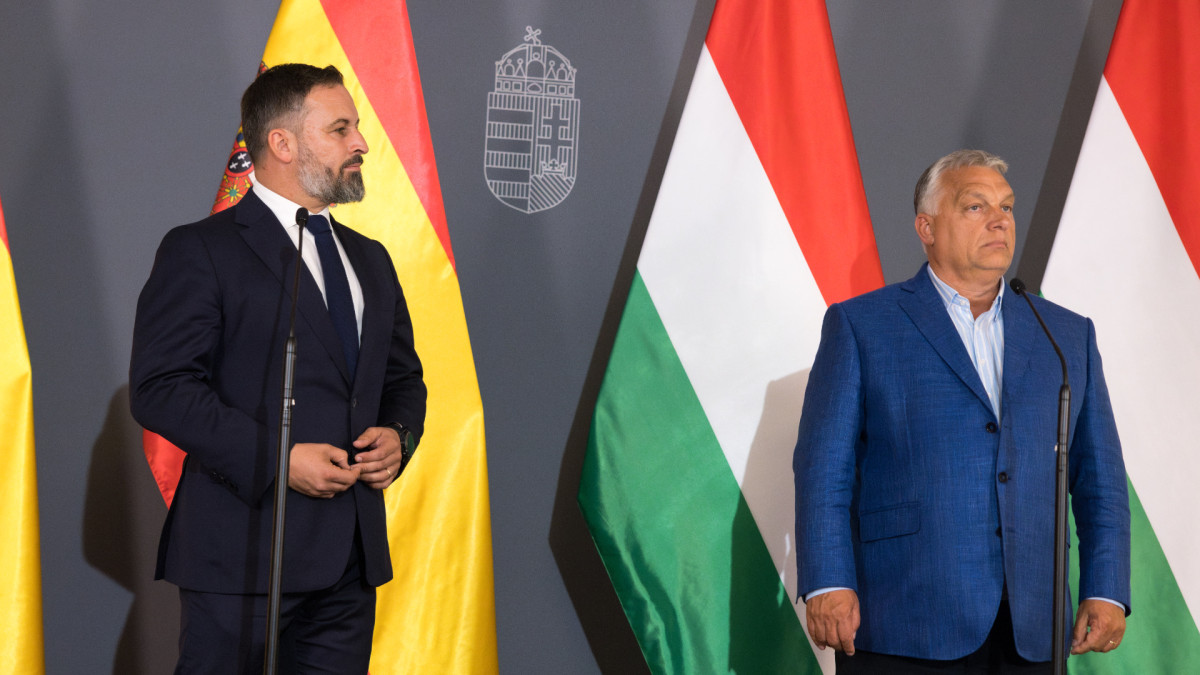
Just three weeks ago, Santiago Abascal stepped onto a stage in Budapest, before hundreds of Fidesz supporters, declaring that Viktor Orbán is “the true defender of Europe” and that “Hungary is an example for Spain”. It was not the first time, nor will it be—the polls seem to indicate— the last time that message will resonate, though perhaps now only as the epitaph of an alliance that is about to lose its strongest pillar. For a long stretch, the Hungarian capital has been more than a mere ideological reference; it has also functioned as a model of power, a strategic ally, and a key node in a transnational right-wing network, with links spanning from Moscow to Tel Aviv, and passing through Washington and Madrid.
For this reason, a potential defeat of the Hungarian prime minister would have direct effects on the Spanish formation, both in symbolic terms and in its capacity to influence Europe, in its channels of support, and in the political horizon that Abascal has projected in recent years: the aim to orbanize the country.
That model has yielded concrete translations: from structural reforms of the institutional system — changes to electoral law, control of independent bodies, or a media landscape concentrated to around 80% — to initiatives such as the 2018 so-called “slavery law”, which substantially expands overtime and delays its payment. There are also laws that tie child protection to restrictions on LGBTQ+ content, affecting even their visibility in public spaces such as bookstores. Beyond each specific measure, what matters is the pattern: a profound redesign of the rules of the game.
The erosion of Orbán’s model in Hungary
Over sixteen years, this project has consolidated as the most complete example of “illiberal democracy” within the European Union. Outside the union, it is a touchstone for figures like Donald Trump. Yet the model shows signs of wear today. In that wear, the economy has played a key role: inflation above 25% in 2023, the highest in the bloc; there is a sharp rise in food prices and the emigration of skilled young people from the country remains above the European average.
“The illiberal democracy works while it distributes welfare; when it stops doing so, its logic of power is exposed”
Moreover, the deterioration has clear indicators: poverty has risen from 31% to 41% between 2021 and 2025, and European funds frozen due to breaches of the rule of law have become one of the main arguments driving the cyclical shift. The economy, that terrain on which orbanism prided itself, has ended up becoming its Achilles’ heel. The illiberal democracy works while it distributes welfare; when it stops doing so, its logic of power.
In this context Péter Magyar emerges, a former member of the Fidesz milieu. His profile — insider of the system — allows him to challenge the disenchanted conservative vote with greater credibility than previous oppositions. He has also distanced himself from Vladimir Putin, breaking one of the strategic axes of the current government. All the same, even an electoral victory would not guarantee an immediate change: the European Parliament has defined Hungary since 2023 as an “electoral autocracy”, with an institutional fabric difficult to reverse without reinforced majorities.
This framework helps explain what is at stake for Vox.
What Vox would lose in Europe if Viktor Orbán falls
In the community arena, the loss of its main ally would weaken its position in the European Parliament. The party has six MEPs and forms part of the group Patriots for Europe, led by Santiago Abascal himself. However, its heft is smaller than that of other delegations: the Rassemblement National of Marine Le Pen hovers around thirty seats and Matteo Salvini’s Lega reaches eight. Without Orbán as a reference figure, internal balances would shift and Vox’s influence would likely shrink. Vox does not have enough critical mass to sustain that position on its own.
On the financial front, the connections are also relevant. Vox has acknowledged receiving financing from the Hungarian MBH bank, close to the government circle, through two loans — one for 6.7 million and another for 2.6 million, totaling 9.23 million euros — to fund the 2023 campaigns. These loans, with interest around 11%, doubled the usual market rates in Spain. The case was examined by the Court of Auditors and did not lead to sanctions after the full repayment in a single day. Beyond the formal outcome, the episode raises questions about dependence on external financing tied to a foreign government.
The context adds another layer: in the same period, the formation allocated around 2.5 million euros to the Disenso Foundation, its main think tank. In other words, it combined external funding with the strengthening of its ideological infrastructure.
“That cultural battle — beyond its concrete content — has served to articulate a transnational political identity in which Vox has fully integrated”
In the discursive dimension, Budapest has been also a center of irradiation. The ecosystem of foundations and spaces linked to orbanism has propelled an antiwoke agenda that has found echoes in different countries. That cultural battle — beyond its concrete content — has served to articulate a transnational political identity in which Vox has fully integrated.
Added to this is the geopolitical dimension. The relationship between Hungary and Vladimir Putin’s Russia has endured for years, with at least sixteen bilateral summits since 2005 in areas such as energy, economy, or culture. This connection has placed Budapest in a singular position within the EU, often at odds with the community consensus. For Vox, that engagement has also provided a window into that international space.
For all these reasons, a defeat of Orbán would have cascading effects. It would alter the EU’s geometry, reducing the blocking capacity in the Council and promoting more cohesive dynamics. It would also weaken the radical-right narrative: the idea that it is possible to consolidate a stable illiberal model without paying electoral costs.
And above all, it would call into question the viability of the project itself. It is not merely about concrete measures, but about a deep transformation of the political system. If this model loses support at the polls, its capacity for external projection is diminished.
For Vox, this implies more than the disappearance of a key ally. It means watching the frame of reference that has guided part of its strategy in recent years erode, as well as one of its most significant political and financial connections.
The final lesson, however, goes beyond a single case. Even after long periods in power, with institutions shaped and rules adapted, no system is completely invulnerable.
Because there is a limit that no political architecture can wholly erase: the vote.
