
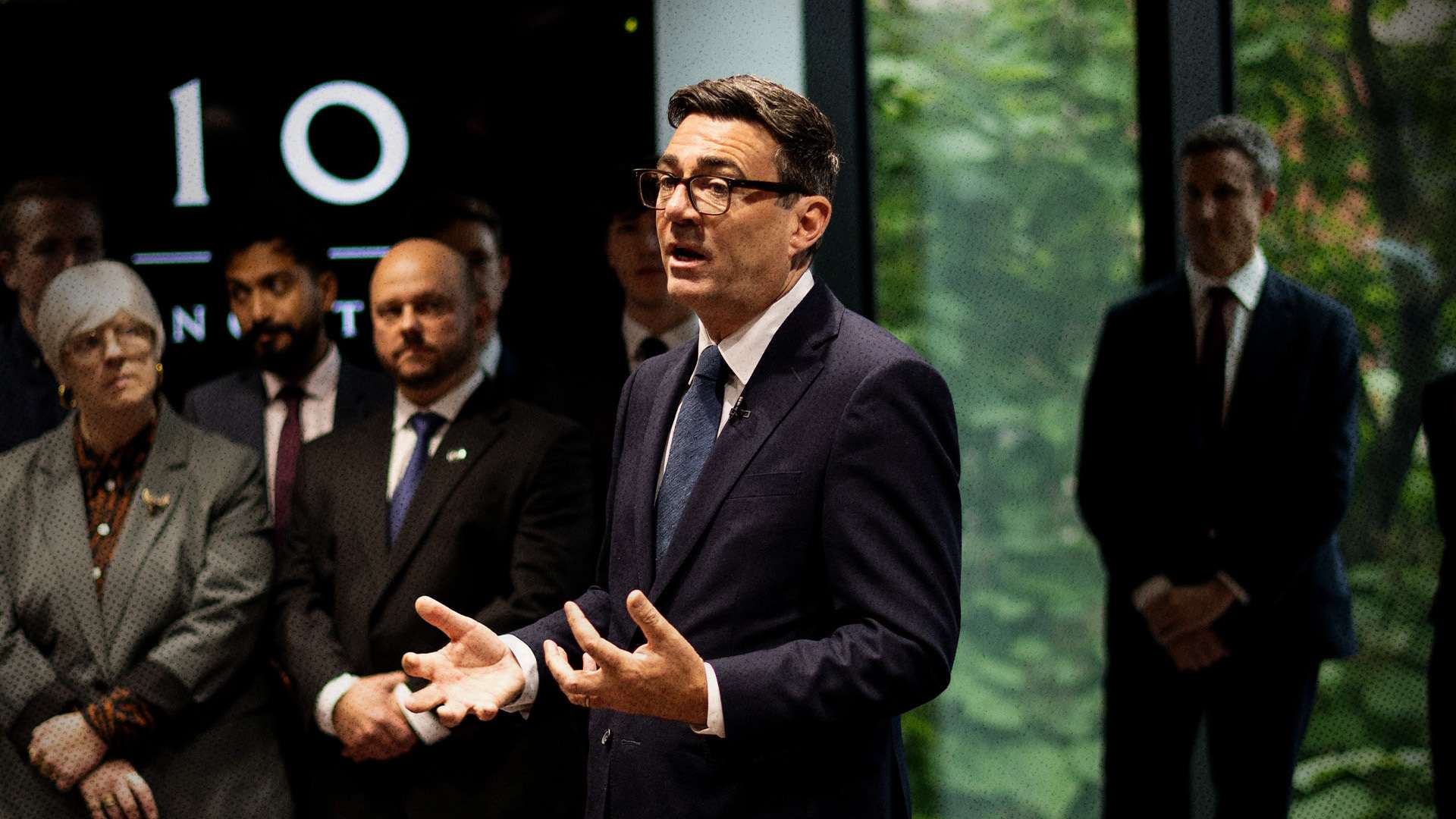
Taxpayers have already paid $14,300 for branding the new office—and more than $1,300 for moving a replica Downing Street door to Manchester, according to a Freedom of Information request.
Britain is grappling with a string of economic challenges: stubborn youth unemployment, stagnant wages (notably when compared with American workers), and a widening deficit. What, then, is the new prime minister’s sweeping strategy to lift Britain from its economic malaise? A fresh government office.
In July, Prime Minister Andy Burnham unveiled the launch of “No. 10 North,” housed in Heron House—a refurbished 1980s office block in Manchester, where Burnham had served as mayor for nearly a decade. A government press release termed it “the government’s new hub for growth,” while Burnham described it as a way to shift power away from Westminster, the epicenter of British political life.
Recently, in a conversation with The Times, Burnham explained that No. 10 North would assume responsibility for driving economic growth. “It is a substantial transfer of power…having No 10 leading on that growth mission means you’ve got maximum power to unlock the blockages within the broader governmental system.”
In essence, the administration’s main growth plan appears to be a new venue for meetings that would ordinarily take place in London.
“What we’re bringing is a different type of energy,” said Caroline Simpson, the office’s deputy chief of staff, to Politico. “That’s really the point about No. 10 North—to connect our places, to reconnect devolution with the heart of governing.”
Whatever that means, the move has already been financed by the public purse. A Cabinet Office letter responding to a Freedom of Information request filed by Reason indicated that simply establishing No. 10 North has cost taxpayers nearly £49,000, or more than $66,000.
This total includes £10,527.20 (more than $14,300) for “physically branding the office,” £1,768.43 (about $2,400) for crockery, and £978.87 (over $1,300) for moving a replica Downing Street door to Manchester.
The government also spent £18,718.23 (more than $25,500) on IT and communications infrastructure, £8,799 (about $12,000) on “enabling works to the office space,” £6,082.38 (around $8,300) on event equipment, lighting, and flagpoles, and £954.16 (more than $1,300) on transporting 24 meeting chairs.
Of course, these sums are a drop in the bucket compared with the £1.4 trillion the British government expects to spend in the 2025–2026 financial year. Yet they are also far from representing the total public outlay tied to this PR operation. In response to Reason’s request, the Cabinet Office did not disclose staff costs, ministerial travel, security expenditure, or ongoing operating costs. But with the prime minister working from the Manchester office at least once a week, and his ministers regularly traveling north, the total cost will not be small.
As The Times reported in July, security for the site costs run into the tens of millions of pounds. The cheapest advance London-to-Manchester train ticket can be as low as about $32, while a same-day purchase may approach $155. Yet, as small-business owner Lewis Kemp found, a return trip from Manchester to London can be as high as $463.
Sam Lister, No. 10 North’s director general, has already been accused of “wasting taxpayer money,” allegedly spending £800 per week on a 200-mile weekly commute from London to Manchester, according to LBC News.
“Whatever the price, I don’t believe security costs should obstruct a government from spreading the center of power further across the country,” a Westminster source told The Times.
Taxpayers may never learn the full cost of running the two offices for the prime minister. Nevertheless, No. 10 North offers insight into how British politicians view governance. Rather than tackling Britain’s most pressing problems, Burnham is pushing expensive plans—such as greater public control of utilities, more government housing, and now another government office facility—which risks enlarging the state and intensifying the UK’s economic challenges.
The new office doesn’t fix flawed policy, but it does provide a strong photo opportunity.
