
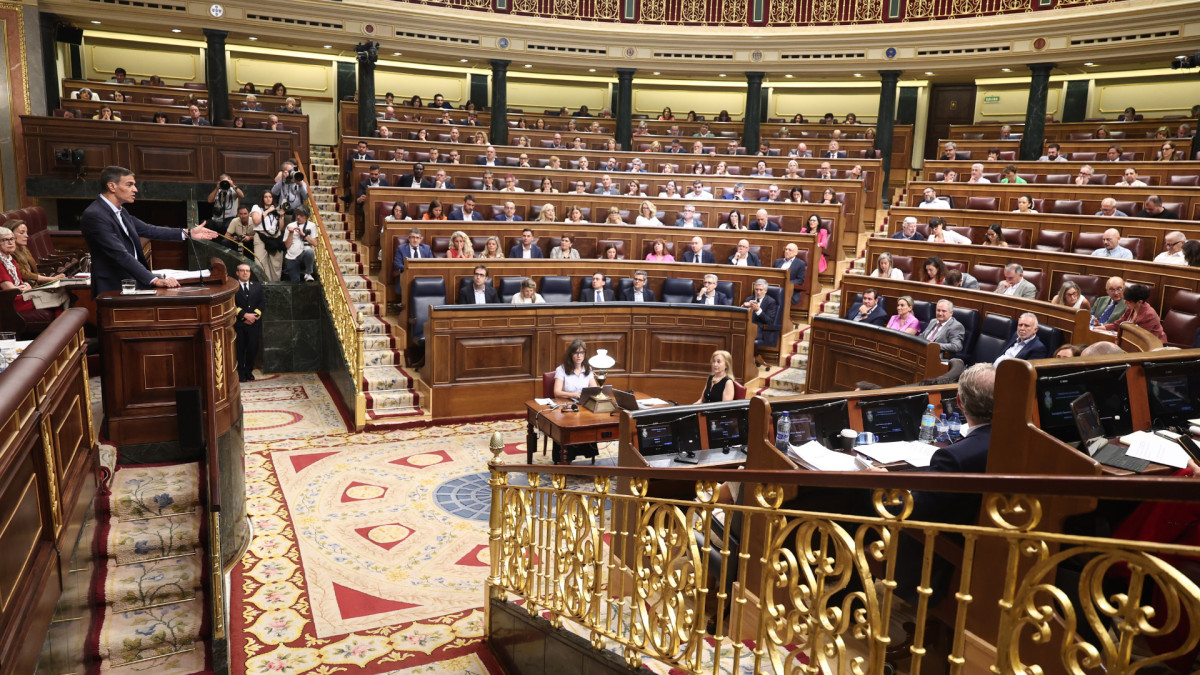
A recent article highlights the low productivity of the legislature that has just ended. 34 laws have been enacted, compared to an average of 148 per legislature and 118 in the one immediately before it. It is the lowest figure since the restoration of democracy, and it can be explained at least by three factors.
First, the government’s parliamentary weakness may have deterred it from presenting bills that, due to the arithmetic of the Chamber or the cost of negotiating support, had little chance of prospering. Second, a substantial portion of the legislative initiative was started by parliamentary groups, not the Executive: 12 of the 34 laws (35%, the second-highest percentage of the period) began as bill proposals and, after negotiation and the final vote, ended up approved. This data confirms a well-known pattern: when the Government only has a relative majority, Parliament recovers part of the legislative initiative.
“When the Government only has a relative majority, the Parliament recovers part of the legislative initiative”
The third relevant factor in understanding parliamentary dynamics is the recourse to the royal decree-law, a figure relatively exceptional in European constitutions. The royal decree-law (RDL) was constitutionally designed (Article 86) as an extraordinary and provisional practice to address urgent matters that do not affect basic rights and freedoms, the ordering of the fundamental institutions of the State, electoral law, or the regime of autonomies. It is provisional until it is validated by the Congress (it is accepted or rejected) or processed as a bill under the urgent procedure, which allows some negotiation in the chamber.
This constitutional design introduces several incentives for the Executive to lean toward legislating through this route. First, procedural incentives: when the Congress votes, the decree is already in effect. Voting against can amount to repealing pension increases, social aid, or emergency measures that citizens are already receiving. Second, the vote is on the whole text and without amendments, which preserves the Government’s text against the negotiation that a fragmented chamber without clear majorities would push toward in order to pass a law, a long and costly process.
Third, institutional incentives: convalidation only goes through the Congress, which allows avoiding the Senate, a relevant factor when the Government and the group or groups backing it do not control the upper house, as in this latest legislature. The RDL also avoids public consultation and reports from various bodies such as the Council of State or the CGPJ. And constitutional oversight is lax and slow.
Fourth, political incentives: the RDL enables announcing a popular public policy with immediate effects, which proves rewarding in terms of claiming merits for the government’s action.
All Governments without exception have resorted to the decree-law as a legislative instrument. A total of 787 royal decrees-laws have been validated since 1977. On average, in each legislature, 54 RDLs have been convalidated, excluding the three shortest. As shown in Figure 1, those who have used this route the least were those of Felipe González and Rodríguez Zapatero. Those who have used the RDL the most were the Sánchez coalition government in the previous legislature with a relative majority (97), Aznar’s government in the VI legislature with a relative majority (85), and Rajoy’s government in the X legislature with an absolute majority (76). Close behind is Suárez’s government in the first legislature after the constitutional reform (73), also with a relative majority.
In this legislature, the Government has resorted to the RDL less than in the previous one, when its use surged well beyond that of any other Government (largely due to the crisis caused by the pandemic and the adoption of a unified command by the Executive). Even so, the proportion remains striking: the Congress has approved 34 laws and has received 70 royal decree-laws for convalidation. In other words, more than two decree-laws per law.
It is true that the Pedro Sánchez governments diverge from the pattern of other Socialist Governments, more cautious with a figure that has ceased to be exceptional. But what sets this legislature apart from all the others is the distance between the RDLs presented and those convalidated, as also shown in Figure 1. The usual democratic pattern has been that the Government gathered the votes needed for convalidation. In the XV legislature that pattern breaks: of the 70 decree-laws approved by the Council of Ministers, the Congress only convalidated 43 (61%), although this percentage is likely to rise when some of the RDLs remaining to be voted on in the Permanent Deputation are convalidated.
“In the XV legislature, the decree-law not only substitutes for the law: it replaces bloc-to-bloc negotiation with a sequence of faits accomplis and vetoes”
An important aspect of the dynamics of RDL use is the capacity of the Government and the groups backing it to directly bring the opposition into the voting to convalidate RDLs. To analyze this, we apply the inclusion index. The index ranges from 0 to 1, where 0 indicates a norm approved solely by the Government’s group or groups, and 1 indicates a measure that passed without anyone opposing it. In the following graph we present the evolution of the inclusion index, comparing the convalidations of the RDLs with the approvals of laws across the latest legislatures.
Except for the second half of the no-confidence motion period, the data show something surprising at first glance: the average level of consensus tends to be higher in the convalidations of the RDLs than in the passage of laws. But this average hides different situations. Agreement in the votes on RDLs clusters into three levels. At one extreme are those that receive no votes against, such as European regulatory transpositions, social measures, or extensions. At another group, with an index between 0.10 and 0.17, are the decrees opposed by the PP and Vox and only sustained by the investiture bloc. The index is not zero because the support from members of that bloc always adds to the index value, so what moves it is whether the PP abstains. Among these extremes, around 0.83, lie the decrees to which only Vox objects. This middle level is not determined by a bloc, but by a single party. Vox has 33 deputies among the roughly 196 others who typically back the Government, so its vote against is enough to prevent surpassing that value. Vox voted against 34 of the 43 convalidated decrees (79%), compared to 36 of 96 in XIV (38%). Much of the drop in the share of decrees with an index below 0.9 thus reflects the shift toward systematic opposition, not a change in the PP’s attitude.
“Much of the drop in the share of decrees with an index below 0.9 thus reflects the shift toward systematic opposition, not a change in the PP’s attitude”
The PP, by contrast, did not oppose 36 of the 43 convalidated decrees. In the intermediate group of RDLs the PP voted in favor of 18 and abstained on 9, especially in those related to public transport, extensions of anti-crisis measures and partial pension; The confrontation between blocs, with the PP opposed, is limited to seven decrees, almost all of territorial content, foreign policy, or omnibus in nature, which only pass with the entire investiture bloc and by margins of 171 to 179 votes in favor or abstentions. To these must be added the 13 repealed decrees, not shown in the data, in which the PP and Vox added their votes to those of Junts or Podemos.
Between the XIV and XV legislatures, the median falls from 0.98 to 0.84, and decrees with broad cross-party support rise from 61% to 21%. As the previous breakdown shows, that drop is mainly due to Vox’s systematic opposition, while confrontation with the PP is limited to a small set of convalidated decrees and, above all, to the repeals. It should be noted that the data only include convalidated decrees. Repealed decrees, such as housing, do not appear, so the actual agreement of the XV legislature is even lower. Even so, it can be said that bloc politics, so visible in the case of passing laws, does not operate as automatically in the case of decree-laws.
This pattern is consistent with the incentives created by the procedure itself. For opposition parties (and very particularly the PP), voting against carries a high cost when it comes to urgent measures (such as those related to natural disasters) or measures whose beneficiaries are widely represented in their electorate (such as pension revaluations). In other cases, the RDL is used to transpose Community legislation within the fixed period, since the process as ordinary law significantly lengthens the timelines. Also here, opposing can be costly for those traditional parties that are in opposition but have voted in favor of said legislation in the European Parliament.
But a relevant veto has been established this legislature, which is also reflected in the votes on RDLs. When Junts’ vote joins that of the PP and Vox, a majority appears that can only repeal, but not propose alternatives in common. That majority toppled the omnibus decree in January 2025 and, by 2026, the social shield on two occasions and the ‘lobbies’ decree. Therefore inclusion in decree-laws falls in the XV to its minimum (0.74) and repeals cease to be exceptional. In the XV, the decree-law not only substitutes for the law: it replaces bloc-to-bloc negotiation with a sequence of faits accomplis and vetoes.
“In the XV, the decree-law not only substitutes for the law: it replaces bloc-to-bloc negotiation with a sequence of faits accomplis and vetoes”
The data reveal a gap between what is perceived and what is voted. In Congress, bloc confrontation dominates, but in votes on RDLs the PP acts as an opposition that cooperates, driven by incentives, while the real isolation belongs to Vox, which uses its vote as a position-taking stance against nearly any initiative. The citizenry, however, perceives the conflict above all, which can fuel distrust in institutions due to the difficulty parties have in solving basic problems. Abstention, which allows the PP not to block without taking ownership of the rules, serves as a timely escape route from normative paralysis, but blurs the attribution of responsibilities: voters may not clearly perceive which policies the opposition supports, and the Government can present as its own achievements measures that would not go forward without the opposition’s (more or less openly tolerated) participation.
A quick reading of the data could lead us to the paradoxical conclusion that the use of decree-laws can favor agreement in times of bloc politics. Nevertheless, the same incentives that push for decree-law approvals to keep day-to-day governance afloat are what hinder broader accords on deeper issues, which may contribute to generating a sense of a democracy that is not working well.
