
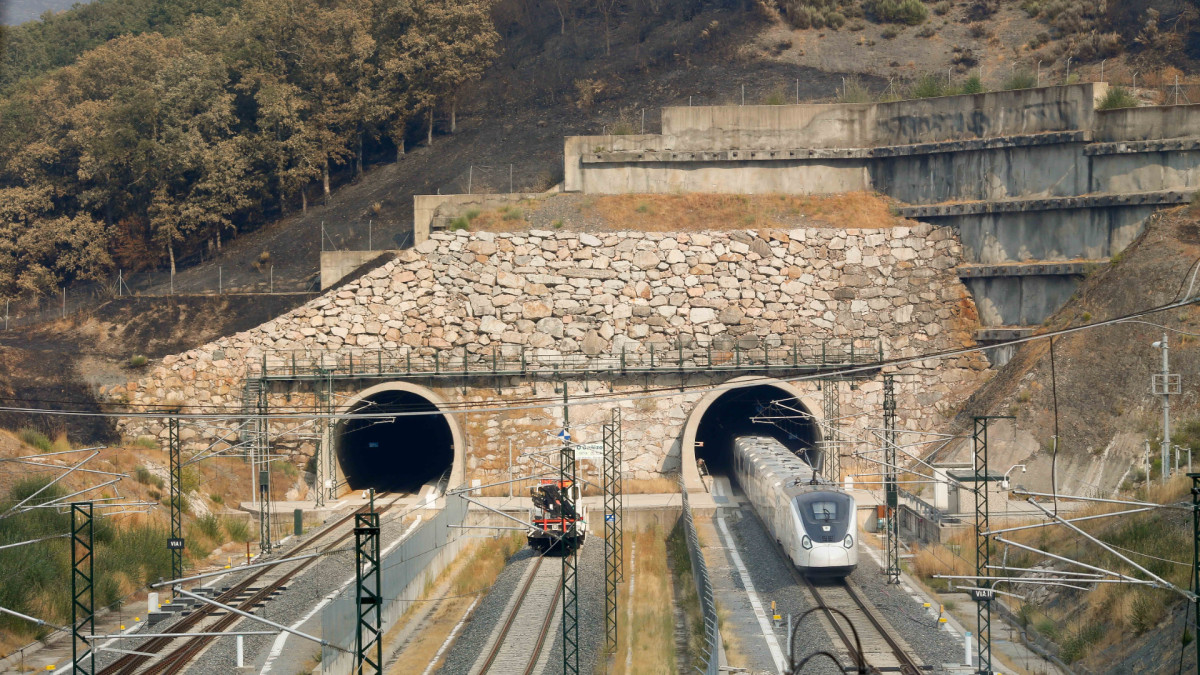
Spain is living in a paradoxical situation when it comes to infrastructure. In most major public policies there are marked differences between the PP and the PSOE. In education, every change of government has translated into a new basic law and into changes in university entrance exams, while there remains a constant debate about support for public universities and the requirements for creating new private institutions. In healthcare, despite the structural continuity of the system, the differences between management models, especially regarding private participation, continue to shape political confrontation. In energy, the shift from Rajoy’s solar tax to Teresa Ribera’s firm commitment to renewables demonstrates the distance between the various political options.
“It is difficult to identify substantial differences in road, rail, or airport policy among the different governments”
However, this pattern does not recur in the field of transport infrastructure. It is difficult to identify substantial differences in road, rail, or airport policy among the various governments of the recent decades. Beyond the discussion about private sector participation in the management of the system (such as the partial privatization of the airport operator Aena), there is a notable strategic continuity from the governments of Felipe González to the present.
The decision taken in the nineties to generalize free motorways in place of the old national roads marked a turning point. Since then, the expansion of high-capacity networks without charges has been constant. In the railway sphere, after an initial push to consolidate a metropolitan railway and the creation of Cercanías, the initial success of the Madrid-Seville AVE line consolidated high-speed as almost the sole investment priority of the system, while the Cercanías network lost funding and quality step by step.
Infrastructure as an axioma
Infrastructure policy constitutes, de facto, one of the few state policies in Spain. There is cross-cutting consensus around an implicit premise: increasing the stock of infrastructure is always positive and constitutes a direct engine of economic development and territorial cohesion. The increase in the number of kilometers of motorways or high-speed lines has been treated as a sign of progress. And this despite the conclusive academic literature that denies it. The evaluation carried out in 2020 by the Independent Authority for Fiscal Responsibility (AIReF) found the lack of social, environmental, economic, and territorial profitability in most of the high-speed network, and recommended changing course, prioritizing Cercanías and reevaluating all pending AVE sections.
“Rarely is there consideration of what would be the effect of using resources invested in roads or asphalt on research, innovation, human capital, or industrial policies”
Continuity goes hand in hand with an absence of a solid debate about the opportunity of undertaking each new project. Rarely is there consideration of what effect allocating resources to roads or asphalt would have on research, innovation, human capital, or industrial policies. The discussion is not framed in comparative terms between sectors, but only within the transport sphere itself.
This lack of analysis is especially relevant considering that Spain already has a level of high-capacity infrastructure well above the European average and above that of the main economies on the continent. With nearly 4,000 kilometers of high-speed lines, we far surpass Germany, Italy, or even France. The same applies to the number of kilometers of motorways and expressways. The question is no longer one of convergence but of the diminishing marginal returns of new investments.
To this dynamic has been added the successive approval of infrastructure plans that add new actions to those already planned, both on roads and on high-speed lines. The result is that, despite the enormous investment effort made over decades, there is always a sense that something remains to be done. The plans are so ambitious that they generate unattainable territorial expectations. Regional and local administrations readily find grievance arguments in works not executed or delayed relative to the schedules envisaged. This consolidates a dynamic in which local political pressure favors the continual inclusion of new projects, even when their priority from the perspective of the national or regional network is debatable or their effects on overall mobility are very limited.
The inertia: when will Spain stop building AVE and motorways?
Changing the inertia is not easy. The latest management team at the Ministry of Transport began by questioning, for example, the AVE Seville-Huelva: “It’s going to take us a lot of time and an enormous investment […] with a third of the investment, we could solve it much sooner, and the difference between the two is ten minutes”. A year and a half later, all the necessary projects are already underway to build a direct AVE between the two cities in less than twenty-five minutes. A similar point can be made about the project to increase the Madrid-Barcelona line speed to 350 km/h.
“Public works have come to be identified with progress, modernization and territorial cohesion. In that context, proposing limits is politically very costly”
Another equally significant example was the impossibility of approving in Congress the measure foreseen in the Recovery Plan and agreed with the European Commission to establish “a mechanism for paying for the use of the state roads […] with the aim of internalizing the external costs of road transport, creating incentives to achieve greater efficiency in this sector”. Not only did the PP and the entire sector oppose it, but even Podemos, then in government, announced its unfavorable vote.
But it is unfair to attribute all responsibility to politicians. The expansion of infrastructure has counted and continues to count on broad social support. Public works have been identified with progress, modernization and territorial cohesion. In that context, proposing limits is politically very costly, since the party in opposition at any given time immediately uses it in local debates, with the support of all social actors.
All the evidence points to a strategic reorientation in terms of transportation infrastructure. The first change has to do with prioritizing maintenance over increasing the stock of infrastructure. We have built so much that the need to spend on maintenance has multiplied and, therefore, in a context of budget constraints and the impossibility of increasing resources through user fees, it is essential to redirect efforts. It is important not to forget that the 2008 crisis severely reduced spending and investment, and although the situation has changed with the arrival of Next Generation funds, the increase in spending has not compensated for the huge deficit accumulated during the crisis.
The second strategic twist concerns the need to redirect efforts toward metropolitan networks. In a context of strong demographic growth and rising housing prices, it is essential to improve and extend the high-capacity transport networks in the main urban areas of Spain.
Finally, the need to reorganize investment priorities in light of the geopolitical context is increasingly evident. The Letta and Draghi reports are a good guide in this: It is essential to strengthen the single market and European competitiveness through massive investment in innovation, digitalization, energy transition and human capital. It would make little sense for Spain to continue prioritizing in the coming decade investments to further increase the current over-supply of transport infrastructure.
