
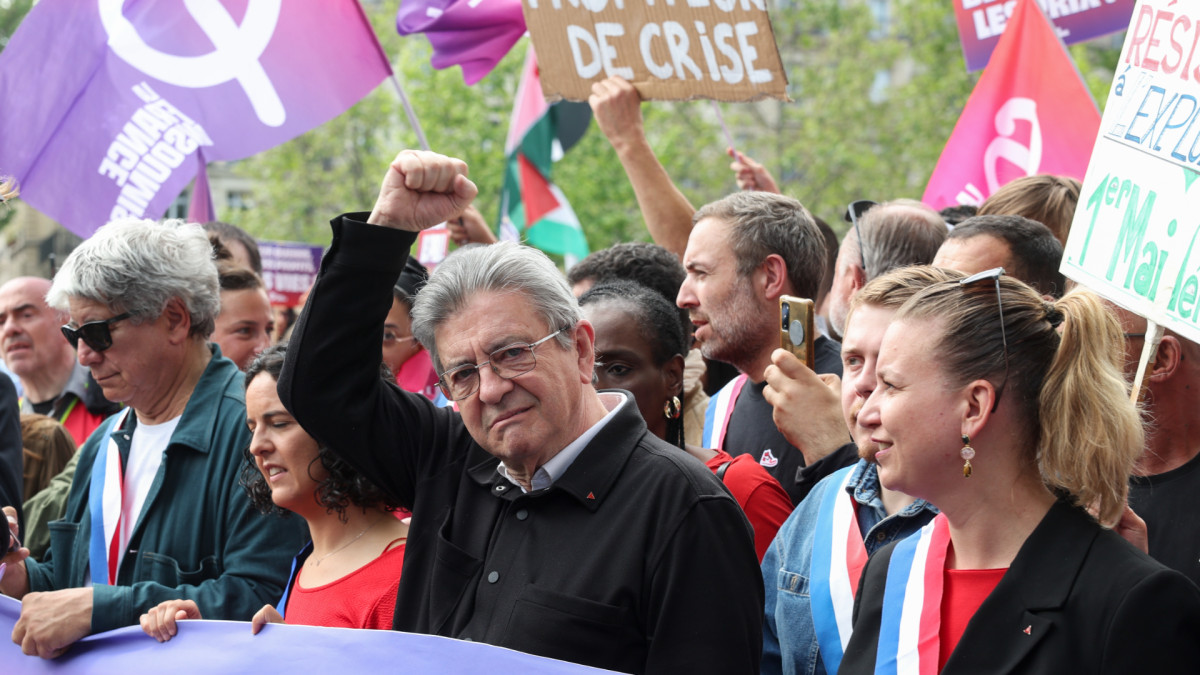
Against the backdrop of the French 2027 presidential elections, the Jean-Jaurès Foundation presents a study on the state of the left, a space that accounts for 29% of the country’s electorate. Based on four differentiated groups, researcher Antoine Bristielle examines the various families of the left and their electoral leanings, considering the value systems and aspirations that drive each of them. It is a thought-provoking analysis in itself and, in particular, for what it allows observing or inferring about the political attitudes of younger generations.
The first dividing line among these groups is the degree of radicalism, and even violence, that each is willing to accept to reach objectives that, broadly speaking, are similar: healthcare, education, purchasing power, and the reduction of inequalities. The second is the attitude toward Jean-Luc Mélenchon, which ranges from absolute rejection to the view that he is the leader the moment demands. It is true that the personality of the La France Insoumise (LFI) leader often acts as a divisive element. However, as we will see, the largest of these four groups —the 32% of the left— is characterized by a certain pragmatism and could support either Jean-Luc Mélenchon or an ecological candidate if that serves its objective of pushing for radical change.
Who makes up these groups?
The core of La France Insoumise constitutes the first group, representing 20% of the left. It is distinguished by its homogeneity and its project of political rupture. 86% of its members voted for the La France Insoumise leader in the first round of the 2022 presidential elections; 63%, for Manon Aubry’s slate in the 2024 European elections; and they place their willingness to vote for Jean-Luc Mélenchon in 2027 at 8.4 out of 10. As was to be expected, this group brings together its most loyal followers. In addition to aspiring to a profound transformation of French society, it accepts a confrontational strategy and rejects political compromise — 56% do so. It also shows broad support for immigration: only 9% consider there are too many immigrants in France, compared with 15% of the left as a whole.
“The largest of these four groups — 32% of the left — is characterized by a certain pragmatism”
The left of Mélenchon gathers a young population — nearly half under 35 years old—, urban and with a high level of education: two-thirds hold higher education degrees. However, their economic situation is often fragile. 47% say they could not afford an unexpected expense of €400, and only a third say they are satisfied with their lives in this regard.
The second group brings together left-wing individuals who have broken with Mélenchon. In 2022, 41% voted for the La France Insoumise leader in the first round of the presidential elections, while today only 8% believe they will do so again in 2027. This shift stems from a very negative assessment of Jean-Luc Mélenchon: 75% see him as a danger to democracy and 83% consider that he fuels violence.
However, no other candidate stirs real enthusiasm among this electorate, faithful to the traditional principles of the left, such as social justice and broad wealth redistribution. No one within the group contemplates moving toward the center or social liberalism: 43% would look favorably on a Raphaël Glucksmann victory; 23%, on Olivier Faure’s; and 19%, on Marine Tondelier’s.
This electorate, close to the Socialist Party of the 1980s and probably largely composed of middle-class civil servants, is willing to make concessions to avoid violence and distances itself from the idea of radical social transformation. It reflects the positions of the oldest and least-educated segment of the left, but also of the one that has changed the most in the recent period. It occupies an intermediate economic position, with household incomes between €2,000 and €3,500 per month.
“No other candidate stirs real enthusiasm among the second group, faithful to the traditional principles of the left”
The third group, representing 23% of the left electorate, aligns with Macronism and the social-democratic tradition. Although it considers itself left-wing and supports its main demands, it presents itself as moderate and firmly rejects the figure of Jean-Luc Mélenchon. In 2022, almost half of its members voted for Emmanuel Macron in the first round of the presidential elections, and many continue to identify with him.
The Socialist Party — with a rating of 7.1 out of 10 — and The Greens — 5.3 out of 10 — could be its main electoral options in 2027. This group would be satisfied if Raphaël Glucksmann won the election, a possibility supported by 53%. As alternatives, 38% would look favorably on a victory by Édouard Philippe and 34%, by Gabriel Attal.
The group is composed of a relatively aging electorate — 43% of its members are over 60 —, with a high educational level — 65% have higher education — and a rather privileged economic situation: 37% of these households earn more than €3,500 per month.
The fourth group, nicknamed “the left’s useful vote,” is the largest and represents 32% of the left electorate. It is not viscerally opposed to Mélenchon — it does not see him as a threat to democracy — and could support him, but it could also opt for another candidate. In particular, for Marine Tondelier, who resonates with her pronounced sensitivity to environmental issues.
“The fourth group, dubbed ‘the left’s useful vote,’ is the largest and represents 32% of the left electorate”
This electorate, which in the European elections distributed its vote among the different left spaces, wants above all a victory for this bloc. Therefore, it will act based on that objective, on the political offer available in 2027, and on the possibilities of forming alliances. This faction of the left was mainly in favor of holding joint primaries, a wish that seems to have already failed due to the rejection of the various leaders, starting with those of La France Insoumise.
Socioeconomically, this last group resembles the supporters of Jean-Luc Mélenchon. It is young — 47% are under 35 —, urban — the vast majority live in large cities — and displays a higher educational level than all the other groups, including La France Insoumise: 72% have higher education. Its material situation, however, is varied: a third belong to modest sectors; another third to the middle levels; and the last third enjoys a privileged position.
Antoine Bristielle considers that this group of the “left’s useful vote” will be the axis of this space’s electoral offering in 2027. Its size and pragmatic stance give it a central position. In addition, its sociological characteristics — a young, urban, highly educated population —, its ideological determination to overturn the system and a distinctly statist program, based on taking resources from the rich to redistribute them and on exercising strong control over companies. It also highlights its distrust of nuclear energy.
All these elements could concentrate its support around a single candidate. Which one, in his view? Imagining that a large portion of the youth will spontaneously rally to a radical left candidacy may seem bold in a time of profound geopolitical convulsions. The issue deserves to be debated.
The European question
There is a factor that should temper the possibility of an alliance between these two fractions of youth — the first and the fourth groups — namely their attitude toward Europe. Only the most unconditional Mélenchon supporters, included in the first group, show reservations about the European project. Barely a minority, 41%, views France’s membership in the European Union positively. The rest of the left, however, expresses clear adhesion to the European project, stronger the higher the level of education: 64% in the second group, 85% in the third, and 72% in the fourth.
To think that the higher-educated youth would readily vote for Jean-Luc Mélenchon, a candidate openly hostile to Europe and who has not backed France’s aid to Ukraine—under the pretext of promoting a peace policy—may be an optimistic interpretation. It is true that voters tend to attach less importance to foreign policy in national elections. But will this remain the case among young French people, especially those with higher education?
The election of Donald Trump in 2024 has triggered deep transformations in the geopolitics’ balances and alliances. His political maneuvers isolate Europe and force it to respond decisively, especially in terms of economic strategy and military equipment.
Several studies of highly educated young people — including my own work on the ‘reset’ generation and the works of Anne Muxel and Martial Foucault on Sciences Po students — show their attachment to the European political framework and the economic and cultural benefits associated with it. Among these benefits are fundamental freedoms, especially freedom of movement and freedom of expression. These studies also confirm, in line with that position, their support for Ukraine.
“It is plausible that twenty-somethings and thirty-somethings on the left will hesitate before backing a candidate who, like Jean-Luc Mélenchon, rejects NATO”
It is plausible that twenty-somethings and thirty-somethings on the left will hesitate before backing a candidate who, like Jean-Luc Mélenchon, rejects NATO and maintains a neutral or hostile stance toward Europe. That stance implies, indirectly and at times unequivocally, a support for Vladimir Putin.
In any case, it seems legitimate to question the political behavior of these young people in a context that could put democracy to a decisive test.
© Telos, 2026.

Natalie Foster
I’m a political writer focused on making complex issues clear, accessible, and worth engaging with. From local dynamics to national debates, I aim to connect facts with context so readers can form their own informed views. I believe strong journalism should challenge, question, and open space for thoughtful discussion rather than amplify noise.