
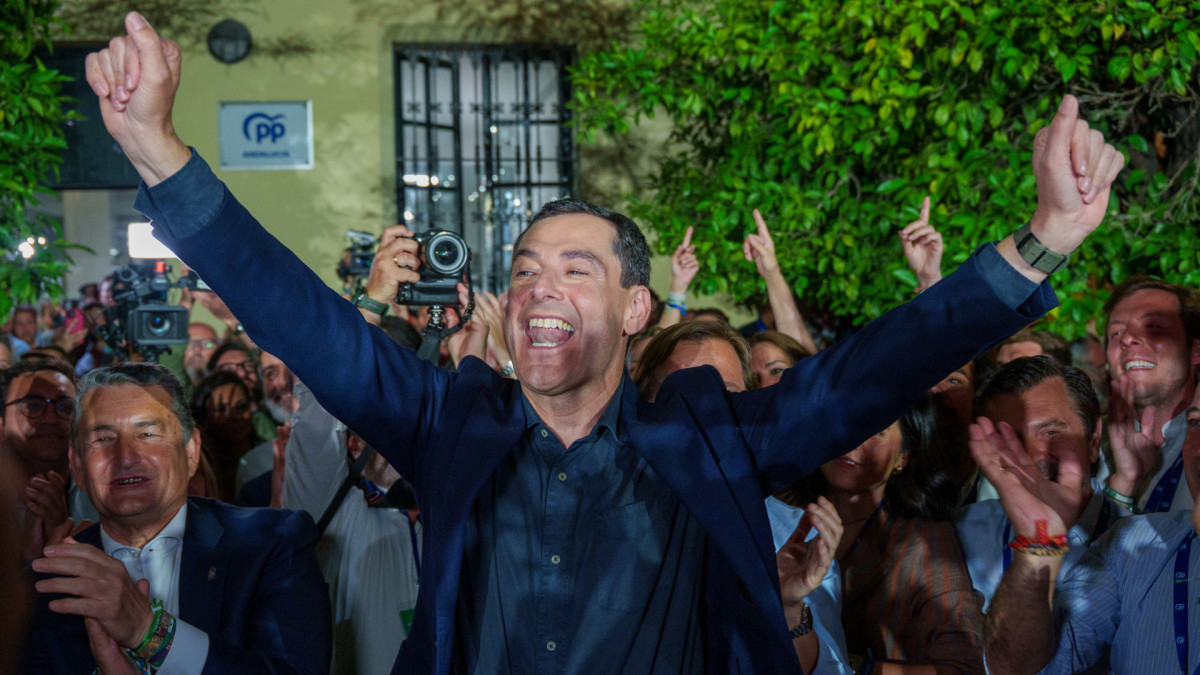
The regional elections in Andalusia mark the end of the cycle that began last December in Extremadura and reinforce the narrative that the conservative bloc remains strong, but fail to demonstrate that there exists a new broader social majority compared to the 2023 general elections. At the same time, they also leave the message that the PSOE avoids a scenario of collapse due to the wear of Pedro Sánchez’s government.
The superficial reading of the results — focused on seats, institutional hegemony and the territorial leadership of the PP — may lead one to think that Andalusia consolidates a virtually irreversible wave favorable to Alberto Núñez Feijóo and, more broadly, an expansion of the right. However, if one pays attention to the evolution of the vote, the image is different: the Andalusian regional elections reaffirm dynamics that had already appeared in Extremadura, Aragon or Castilla y León and point toward a much more competitive scenario in future general elections.
Andalusia and the Best Possible Scenario for the PP
The key difference is that Andalusia was, probably, the most favorable possible territory for the PP. Unlike other autonomous governments subjected to wear or Vox dependency, Juanma Moreno started from an exceptionally strong position: an absolute majority, no internal conflicts, consolidated leadership and a moderate image capable of attracting centrist voters. Precisely for that reason, the fact that the PP fails to expand the conservative bloc beyond the 2023 levels is significant and symptomatic.
“PP and Vox are able to mobilize, even in a regional context, practically the same volume of voters that they already mobilized together in the 2023 general elections”
The first major trend that emerges is the nationalization of the anti-Sánchez vote in regional elections. Andalusia shows that PP and Vox are capable of mobilizing, even in a regional context, nearly the same number of voters that they already mobilized together in the 2023 general elections. That phenomenon has a twofold reading. On one hand, it confirms the enormous capacity for political activation of the conservative space when the competition centers on Pedro Sánchez and national polarization. On the other hand, it also reveals a limit: the bloc fails to substantially widen its social base.
The PP matches the historic vote ceiling that Javier Arenas reached in 2008, slightly above 1.7 million votes. Therefore, even in an extremely favorable context —with a weakened PSOE regionally, Ciudadanos absent, and Moreno benefiting from a high personal rating—, the PP still has not shown that it has built a structurally superior majority to the one it held nearly two decades ago.
Part of the popular growth comes, in fact, from a more defensive than expansive phenomenon: the definitive absorption of Ciudadanos’ electorate. The political cycle launched in 2015 had fragmented the center-right space; the Andalusian elections of 2026 seem to definitively close that process. The PP recovers a large portion of those voters lost, consolidating the reunification of the liberal-conservative space. Nevertheless, that does not necessarily equate to an expansion of the right’s electoral coalition.
There are, however, some signs of additional growth relative to 2023. The PP and Vox together gain about 56,000 votes above that result, a figure that probably combines new voters mobilized and previously demobilized socialist voters from earlier cycles. Added to that figure could be the 105,000 votes from Se Acabó la Fiesta. Still, the increase remains relatively modest for elections that the conservative media ecosystem had framed as a plebiscite on Sánchez.
“Vox maintains a relevant capacity for electoral retention, which prevents Moreno from reproducing the hegemonic concentration model that Ayuso partially achieved in Madrid”
From this same perspective, the PP manages to withstand Vox’s competition but cannot neutralize it completely. Santiago Abascal’s party retains a significant ability to retain votes, which prevents Moreno from reproducing the hegemonic concentration model that Isabel Díaz Ayuso did partially achieve in Madrid —and one would need to see what results it would yield today. Andalusia thus confirms that the total reunification of the conservative vote around the PP remains far from complete.
The second major conclusion directly affects the PSOE. Against the narrative of territorial collapse, the socialists show signs of stabilization. The main difference is that, instead of speaking of a full recovery, it is more accurate to speak of “resistance”.
The PSOE breaks, for the first time since 2004, the downward trend in Andalusian regional elections. Simply regaining votes compared with the previous election has considerable symbolic significance in a territory that for decades was the heart of the Spanish socialist vote and that in recent years had become the main symbol of its decline.
“The behavior of the Socialist electorate seems to depend more on contextual incentives than on an irreconcilable disagreement with the party”
At the same time, the evolution of Pedro Sánchez’s party in Andalusia also forces a better contextualization of the results of the 2026 regional cycle. Socialist demobilization does not respond solely to a homogeneous national wear, but also to specific territorial factors. In Extremadura, the PSOE suffered the impact of a badly damaged leadership. In Aragon, internal divisions conditioned the campaign. In Andalusia, the slim expectations of victory limited mobilization. The behavior of Socialist voters, and in particular their final mobilization, seems to depend more on contextual incentives than on an irreconcilable disagreement with the party.
That explains why measuring evolution exclusively in terms of seats can lead to misleading interpretations. Regional electoral systems magnify small variations and turn relatively solid resistances into seemingly severe defeats. In strictly electoral terms, the Andalusian PSOE resists much better than much of the media coverage would suggest.
There is also a third relevant element: a modest rebound of the space to the left of the PSOE. Although limited, it reinforces a hypothesis that Spanish politics has shown since 2015: that electorate responds mainly to dynamics of national competition. When it perceives a significant national dispute —whether to curb the right or to condition a progressive government— its mobilization increases considerably.
What the Andalusian elections imply for future general elections
Taken together, Andalusia leaves a political picture that is less clear than it might appear. The PP preserves institutional hegemony and territorial leadership, but does not yet demonstrate an unequivocal ability to build a broader social majority than in 2023. The PSOE remains far from its historic high results, but the current situation is similar to other times in which it has managed to compete for a majority in general elections. In this regard, the implications that emerge from the Andalusian ballots are several.
The first is that the regional PSOE is not in collapse. Andalusia confirms a stabilization of the socialist electoral floor closer to the 2022-2023 pattern than to a prolonged collapse. The party’s resilience capacity remains greater than many analyses built solely on the logic of government wear would assume.
The second is that Pedro Sánchez continues to depend on an extraordinarily high level of mobilization to compete. In other words, the president needs to re-activate a vote volume similar to what he achieved in 2023, when he turned the general elections into an existential choice for the progressive bloc. Andalusia shows that that electorate does not vanish, but it does not mobilize automatically in regional contexts where the expectation of real change is low.
“The strength of the PP and Vox in the regional elections cannot be mechanically extrapolated to general elections”
The third —and perhaps the most important— is that the strength of the PP and Vox in the regional elections cannot be mechanically extrapolated to general elections. Precisely because the right has nationalized these regional elections, a large portion of its electorate is already voting in national terms. In other words, the conservative bloc is bringing into regional elections many voters who would normally only participate in general elections. The effect recalls, in part, Isabel Díaz Ayuso’s strategy in Madrid in 2021, when she turned regional elections into a permanent national confrontation.
That means that the additional growth margin for the PP in a general election could be smaller than what the regional victories suggest, because the conservative bloc would already be operating near its maximum mobilization capacity. By contrast, the PSOE still preserves a potential reserve of voters that only activates fully under conditions of extreme national polarization.
That is why Andalusia does not necessarily foreshadow an incontestable majority for Feijóo. What it does foreshadow, at least, is a politically blocked Spain, extremely polarized, in which future general elections will again hinge, above all, on the ability of each bloc to mobilize its most intermittent voters.
