
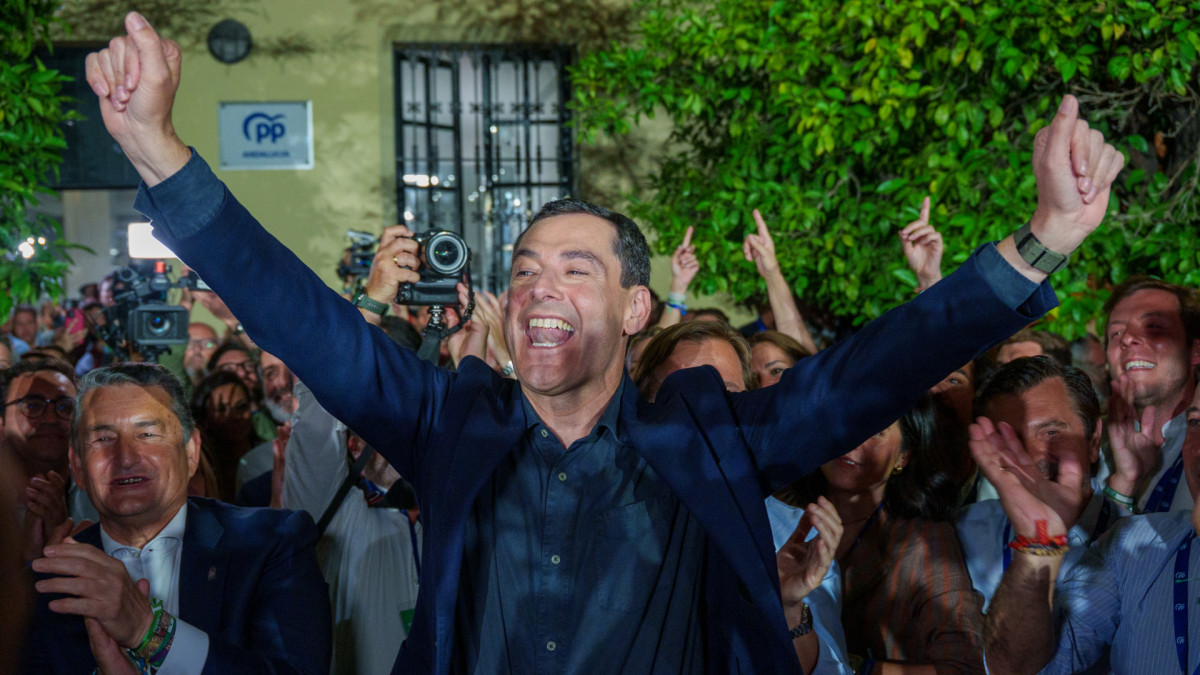
The regional elections in Andalusia conclude a cycle that began last December in Extremadura and strengthen the sense that the conservative bloc remains resilient, yet they do not prove the emergence of a broader social majority compared with the 2023 general election. Simultaneously, they also suggest that the PSOE has avoided a collapse scenario linked to the wear accumulated by Pedro Sánchez’s government.
A cursory reading of the results —emphasizing seats, institutional dominance and the PP’s regional sway— might lead one to think that Andalusia is solidifying an irreversible shift in favor of Alberto Núñez Feijóo and, more broadly, a widening of the right. However, when the vote’s evolution is analyzed, a different portrait appears: the Andalusian regional elections reaffirm patterns already seen in Extremadura, Aragon and Castilla y León, and point to a far more competitive outlook for a future general election.
Andalusia and the best possible scenario for the PP
The key distinction is that Andalusia was likely the most favorable terrain imaginable for the PP. Unlike other regional administrations exposed to political fatigue or dependence on Vox, Juanma Moreno began from a position of exceptional strength: an outright majority, no internal quarrels, consolidated leadership and a moderate image capable of appealing to centrists. Precisely for that reason, the fact that the PP has not managed to broaden the conservative bloc beyond its 2023 levels is noteworthy and telling.
“The PP and Vox are capable of mobilizing, even in a regional context, essentially the same volume of voters that they mobilized together in the 2023 general election”
The first major trend that emerges is the nationalization of the anti-Sánchez vote in a regional election. Andalusia demonstrates that the PP and Vox can mobilize, even at the regional level, roughly the same number of voters they did in the 2023 general election. This phenomenon carries a double meaning. On one hand, it confirms the immense capacity for political activation within the conservative space when the contest centers on Pedro Sánchez and national polarization. On the other hand, it reveals a limit: the bloc is not substantially expanding its social base.
The PP matches the historic vote ceiling reached by Javier Arenas in 2008, standing just over 1.7 million votes. Consequently, even in an exceptionally favorable setting —with the PSOE weakened regionally, Ciudadanos defunct and Moreno enjoying high personal approval—, the PP has not demonstrated that it has built a structurally larger majority than the one it held nearly two decades ago.
Part of the PP’s ascent stems, in fact, from a more defensive than expansive dynamic: the final absorption of Ciudadanos’ electorate. The political cycle that began in 2015 had fractured the center-right space; the 2026 Andalusian elections appear to have definitively closed that process. The PP has recovered a large portion of those lost voters, consolidating the reunification of the liberal-conservative space. Yet, that does not necessarily amount to an enlargement of the right’s electoral coalition.
There are, however, some signs of additional growth relative to the 2023 general election. The PP and Vox together gained around 56,000 votes compared to that result, a figure likely reflecting both newly mobilized voters and former Socialist voters who had become demobilized in prior cycles. The 105,000 votes for Se Acabó la Fiesta could also be added to that total. Even so, the rise remains relatively modest for a contest that the conservative media sphere itself had framed as an early referendum on Sánchez.
“Vox retains a meaningful capacity for electoral retention, preventing Moreno from reproducing the model of hegemonic concentration that Isabel Díaz Ayuso did partially achieve in Madrid”
From this vantage point, the PP has managed to endure Vox’s competition, but not to neutralize it completely. Santiago Abascal’s party retains a significant ability to retain voters, hindering Moreno from reproducing the hegemonic consolidation partially achieved by Isabel Díaz Ayuso in Madrid —although it remains to be seen what results she would get today. Andalusia thus confirms that the total reunification of the conservative vote around the PP remains far from complete.
The second major conclusion directly concerns the PSOE. Contrary to the narrative of territorial collapse, the Socialists show signs of stabilization. The main difference is that, rather than a full recovery, it is more accurate to describe it as “resistance”.
For the first time since 2004, the PSOE has halted its downward trajectory in an Andalusian regional election. Merely recovering votes versus the prior election carries considerable symbolic weight in a region that for decades served as the political epicenter of Spanish socialism and which in recent years had become emblematic of its decline.
“The behavior of Socialist voters seems to depend more on contextual incentives than on an irreparable disagreement with the party”
At the same time, the evolution of Pedro Sánchez’s party in Andalusia also calls for a more nuanced interpretation of the 2026 regional cycle results. Socialist demobilization is not solely the product of uniform national wear; it is also shaped by specific local factors. In Extremadura, the PSOE bore the impact of a notably weakened leadership. In Aragon, internal divisions influenced the campaign. In Andalusia, limited victory expectations curtailed the party’s ability to mobilize. The behavior of Socialist voters, and their final mobilization in particular, seems driven more by contextual incentives than by an irreparable rift with the party.
This helps explain why assessing the evolution solely by seats can yield misleading interpretations. Regional electoral systems amplify small variations and transform relatively solid resistance into appearances of severe defeats. In strictly electoral terms, the Andalusian PSOE has resisted far better than much of the media coverage would suggest. In fact, it is probably the strongest Socialist showing of the 2026 regional cycle.
There is also a third notable factor: a slight recovery of space to the left of the PSOE. Although modest, it reinforces a hypothesis that Spanish politics has been demonstrating since 2015: this electorate responds primarily to national competition dynamics. When it perceives a meaningful nationwide contest —whether to curb the right or to influence a progressive administration—, its mobilization rises considerably.
What the Andalusian elections imply for a future general election
Overall, Andalusia paints a political picture that is less straightforward than it might appear. The PP maintains institutional dominance and regional leadership, but it has yet to prove a clear ability to assemble a broader social majority than in 2023. The PSOE remains distant from its historic highs, but the current situation resembles other cases in which it has managed to contest for a majority in general elections. In this respect, several implications emerge from the Andalusian ballot boxes.
The first is that the regional PSOE is not in free fall. Andalusia confirms a stabilization of the Socialist electoral floor closer to the 2022-2023 pattern than to a sustained collapse. The party’s capacity for resilience remains greater than many analyses based solely on the wear of governing would assume.
The second is that Pedro Sánchez continues to depend on an exceptionally high level of mobilization to compete. In other words, the prime minister must reactivate a volume of votes similar to that achieved in 2023, when he transformed the general election into an existential clash for the progressive bloc. Andalusia shows that this electorate has not vanished, but it does not mobilize automatically in regional settings where the prospect of real change is low.
“The strength of the PP and Vox in regional elections cannot be mechanically extrapolated to a general election”
The third —and perhaps the most crucial— is that the strength of the PP and Vox in regional elections cannot be mechanically extrapolated to a general election. Because the right has nationalized these regional elections, a large portion of its voters already cast ballots with national considerations in mind. In other words, the conservative bloc is bringing into regional races many voters who would typically vote only in general elections. The effect echoes Isabel Díaz Ayuso’s Madrid strategy in 2021, when she converted a regional election into a perpetual national confrontation.
This implies that the PP’s potential room for growth in a general election might be smaller than regional victories imply, since the conservative bloc could already be operating near its maximum mobilization capacity. By contrast, the PSOE still possesses a reserve of voters that becomes fully activated only under conditions of intense national polarization.
That is why Andalusia does not necessarily herald an unchallengeable majority for Feijóo. What it does indicate, at any rate, is a Spain that is politically gridlocked and intensely polarized, where future general elections will once again hinge primarily on each bloc’s ability to mobilize its most wavering supporters.
