
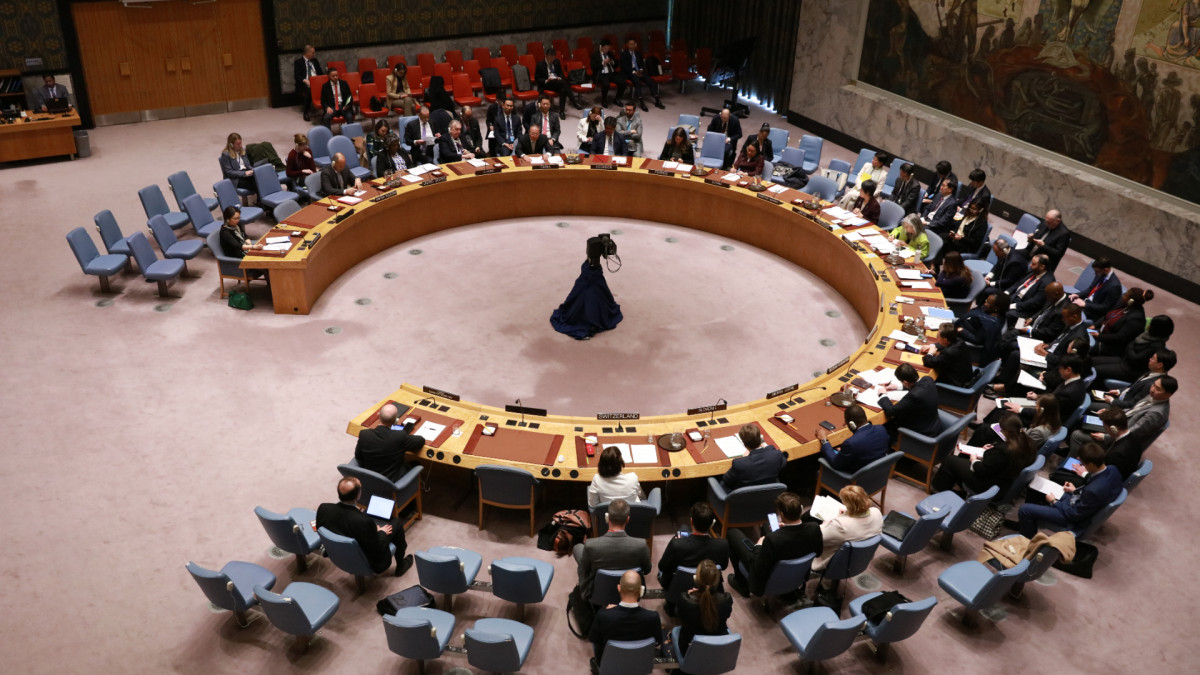
How close are we to the end of the world? This is one of the questions that circulates in the minds of many people, even more so when a state threatens to use nuclear weapons to defend its territorial integrity. It is natural to think that both the threat and the use of these weapons should be prohibited in every respect, but what does the law really tell us? What mechanisms exist to curb the hypothetical apocalyptic scenario we fear so much?
“The Charter does not resolve the issue and seems to leave open the possibility of threatening and using nuclear weapons in the context of legitimate self-defense”
In this sense, the normative corpus starts from Article 2, paragraph 4, of the United Nations Charter, which explicitly states: “The Members of the Organization, in their international relations, shall refrain from the threat or use of force against the territorial integrity or political independence of any State, or in any other manner inconsistent with the Purposes of the United Nations.” However, this prohibition is exempted by two circumstances contemplated in Chapter VII of the Charter. Specifically, with regard to the threat and the use of nuclear weapons, one must adhere to the provisions of Articles 42 and 51 of the Charter, which establish two scenarios: on the one hand, Article 42 allows the Security Council to exercise, by means of “air, naval or land forces,” the action necessary to maintain or restore international peace and security, while Article 51 enshrines the right to individual or collective self-defense, in the event of an armed attack against a member of the United Nations, until the Security Council has adopted the measures necessary to maintain international peace and security. Consequently, the Charter does not resolve the issue and seems to leave open the possibility of the threat and the use of nuclear weapons in case of legitimate defense.
Although it is true that, after World War II (1939-1945), the famous Nuclear Non-Proliferation Treaty opened for signature in 1968 and entered into force in 1970, this treaty focuses on restricting the proliferation of nuclear weapons, although it also includes commitments related to the peaceful use of nuclear energy and disarmament. The distinction between nuclear-possessing states and non-nuclear-possessing states is the cornerstone of the problem, for, as reflected in Article IX, paragraph 3, of the Treaty itself, a possessing state is defined as one that “has manufactured and exploded a nuclear weapon or other nuclear explosive device before 1 January 1967,” the cutoff date established by the Treaty. Curiously, those States are the United States, Russia, China, the United Kingdom and France, which also occupy the five permanent seats on the United Nations Security Council and wield veto power in their substantive decisions.
Consequently, one can deduce that the Nuclear Non-Proliferation Treaty did not aim to end the nuclear arms race, but rather constitutes more of a declaration of intent aimed at defusing the hostilities that followed World War II.
The system, therefore, seems to have been designed to function only for a few. This is evidenced by the International Court of Justice’s 1996 Advisory Opinion, in which the court concludes that it cannot definitively determine whether the threat or the use of nuclear weapons would be lawful or unlawful in an extreme circumstance of legitimate self-defense in which the survival of a State is at stake. This is so, firstly, because, in 1996, there was no universal treaty or customary norm prohibiting the threat and use of nuclear weapons—as there was with biological weapons, another category of weapons of mass destruction; secondly, because there was not a sufficiently general and accepted state practice as a law that would allow the consolidation of a customary norm, given that the political, economic and ideological interests of the great powers actively blocked its formation.
“The court concludes that it cannot definitively determine whether the threat or the use of nuclear weapons would be lawful or unlawful in an extreme circumstance of legitimate self-defense”
The ICJ’s advisory opinion marks a real turning point in international humanitarian law, for it reflects the structural problem of a system that clings to formal interdependence, relegating to the background the universal principles that laid its foundations. The current challenge is, therefore, to ask ourselves about the cracks in the system: how is it possible that the law, a noble and virtuous invention, operates in favor of the players on the board, while harming and leaving the pawns unprotected?
