
Proving that Jennings acted with “actual malice” might prove hard.
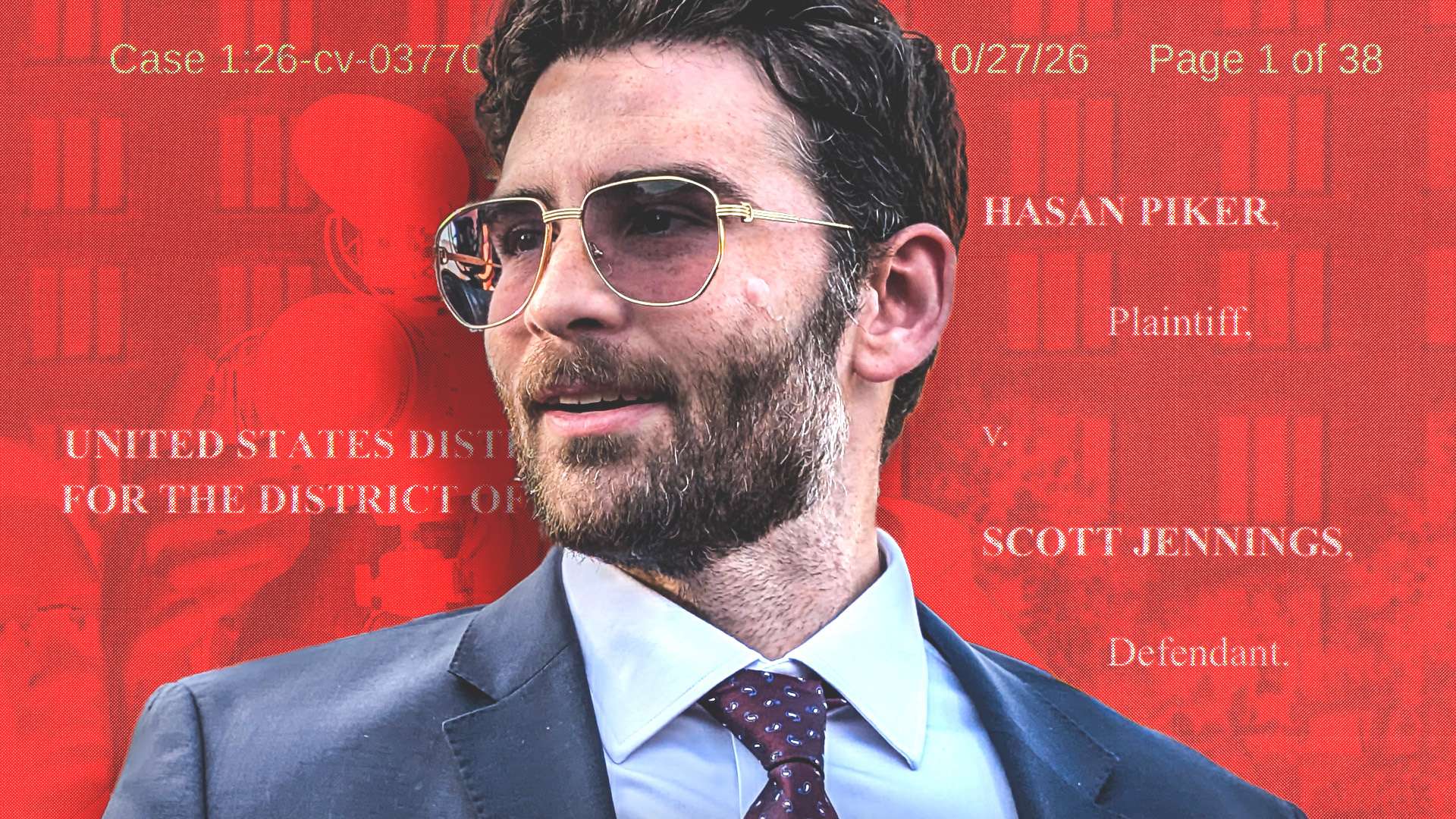
A lesson from this lawsuit filed by lefty streamer Hasan Piker against podcaster and CNN contributor Scott Jennings: sarcasm and hyperbole can come back to bite you. And while I personally enjoy exaggeration and sharp turns of phrase, I understand Piker’s predicament. Still, I’m not entirely sure he will—or should—emerge victorious.
Two years earlier, Piker reacted to a debate in which a Black conservative commentator complained about “woke” district attorneys, and he offered a caustic summary of the argument during a Twitch broadcast:
He said, “We need more Klansmen, okay? Can we go back to a better time when lynchings were happening? This is what I like as a Black man. Also, there’s no real racism in America.” My man said, “woke DAs,” dude. What are you saying?
That’s not exactly a charitable portrayal of the man’s remarks. Perhaps Piker overreacts at times. But at the very least, it’s clear that Piker himself wasn’t expressing a desire to wear a white sheet.
Yet the internet thrives on collapsing context. And so, we got this.
How does Abdul El-Sayed’s campaign surrogate Hasan Piker feel about Black Americans?
Watch for yourself. pic.twitter.com/icGiXek7Ok
— Senate Republicans (@NRSC) August 6, 2026
By stitching together fragments of Piker’s above remarks with several other clips taken out of context, the National Republican Senatorial Committee (NRSC) presented a version that suggested Piker was endorsing lynching of Black people himself.
Subsequently, Scott Jennings played the clip on his podcast/syndicated radio program, stating that Piker was “out there calling for Black voters to be lynched.” A caption on the video read “PIKER: ‘LET’S GO BACK TO A BETTER TIME WHEN LYNCHINGS WERE HAPPENING,'” according to Piker’s complaint.
Piker has every right to feel outraged and to push back against this mischaracterization. But is it defamation?
From a legal standpoint, perhaps not. To prove defamation against a public figure, it isn’t enough to show that a false statement caused harm and was published; one must also prove that the statement was made with “actual malice.”
In this instance, demonstrating actual malice by Jennings could be a difficult task. To meet that standard, one would have to show that he had “knowledge that [his statement] was false” or acted with “reckless disregard of whether it was false or not.”
Even if Jennings had intentionally lied from the start, that would be a hard case to prove. The clip was already circulating when he aired it, propagated not by some random account but by the NRSC. It shows real footage of Piker, not an AI-generated deepfake, and it includes real statements from Piker that were taken out of context. There’s ample room for plausible deniability.
But whether Jennings acted with recklessness in amplifying the story is a more complex question. Given the video’s origin and the fact that it features Piker speaking, Jennings might reasonably contend that, initially, he did not know better. Snopes did a debunking, and Piker’s team emailed Jennings to explain the full context. Yet Jennings left the clip online.
That adds a layer of complication. Even if Jennings did not appreciate at first that the clip was misleading, the full clips should have helped him become aware. And if Jennings was pointed to them and chose not to review them, that could plausibly be deemed reckless—though, of course, we haven’t heard Jennings’s side of the story.
Regardless of the outcome, the case underscores how tangled defamation law can be. There will always be voices arguing that the standard should be easier to satisfy when the defamed party is on one’s own side. But the consequence of that notion is that journalists and news outlets—and perhaps anyone who has ever shared a misleading video clip—could suffer.
The same reasoning that might shield Jennings in this particular dispute also protects journalists who report on people in power, even when those in power dispute the facts or how they are interpreted. It also helps ensure that honest mistakes won’t translate into financial ruin for those who publish and discuss public figures.
In this suit, Piker is seeking $72.5 million in damages. “You have to remember, this is not just about Scott Jennings, although he certainly messed up,” Piker told his Twitch audience on Tuesday. “This is about truth in the media, OK? I think for far too long we have allowed Republicans to get away with saying whatever they want.”
Yet even if defamation law, in its defense of free speech, appears unfair when it permits a false portrayal of someone as pro-lynching, the underlying framework actually protects press outlets, podcasters, Twitch streamers, and anyone who wishes to discuss politicians, celebrities, and other public figures in a public forum. That is not to say Jennings shouldn’t have exercised greater caution. Or that Piker cannot prevail—time will tell. But if he loses, proponents of free press and free speech should pause before using the outcome as a springboard to advocate revisions to defamation law.
