
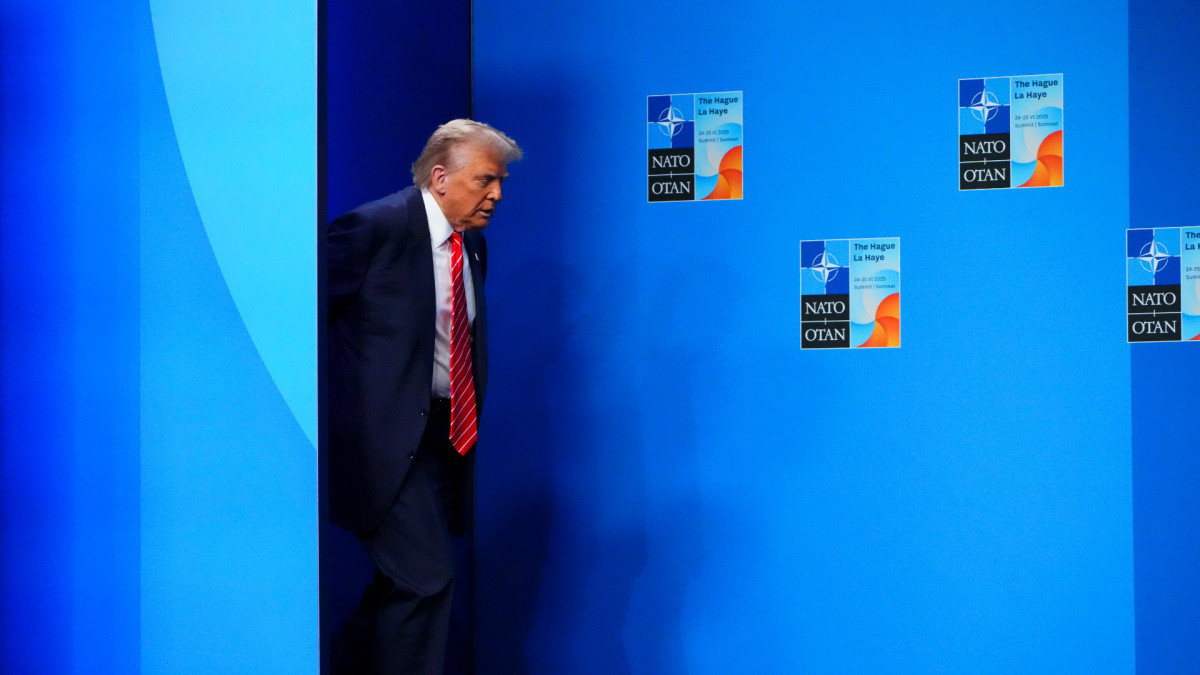
The leak of a Pentagon email, advanced by Reuters yesterday morning, has had an immediate impact on European capitals. Not afraid, but surprised, European leaders have checked for the twentieth time that there exists a huge disconnect between Donald Trump’s White House and the reality of the international legal order. The document suggests that Washington would be weighing a “suspension” of Spain as a member of NATO —accompanied by other coercive measures— due to Madrid’s persistent rejection to align with the escalation of war against Iran. However, despite the pyrotechnic communication that already characterizes the Trump Administration, NATO is neither a toy nor should it be a toy of the U.S. administration.
“Washington has been convinced by Benjamin Netanyahu’s cabinet to wage a war that is neither sovereign nor consensual”
In this new evolution of the Atlantic relationship, the starting point is marked by a Trump unable to achieve his geostrategic objectives. In this sense, his decisions, which confuse many international analysts, seem to have been outsourced to foreign interests. Because while the American president tries to force a united front against Tehran, the perception in Madrid, Rome and Brussels is that Washington has been convinced by the Netanyahu cabinet to wage a war that is neither sovereign nor consensual.
The Fallacy of Unilateral Suspension: The North Atlantic Treaty as a Shield
“In the fourteen articles of the North Atlantic Treaty, none includes or mentions a mechanism of expulsion or suspension”
In its fourteen articles, none includes or mentions a mechanism of expulsion or suspension. Article 13 contemplates only the denunciation of the treaty by a member who wishes to withdraw from the Alliance. Therefore, for the U.S. to “kick out” Spain, Italy or any other “ally,” it would have to propose an amendment to the original text. Following Article 10, this procedure would require the unanimous agreement of all the allies —including the State to be expelled—. Moreover, in the current geopolitical climate, with Berlin and Paris wary of the stability of U.S. foreign policy, the possibility that Trump could obtain that consensus is non-existent.
The New York president is discovering that Spain’s sovereignty is not a gift from Washington, but an international legal status. By threatening a suspension that he cannot legally enact, Trump fails in his attempt to pressure Spain and Sánchez and, in doing so, erodes the credibility of NATO itself. The move turns Article 5 of collective defense into an empty promise conditioned by personal loyalty to his figure. If the dynamic continues, the relationship would look more like a contract with an insurer than the bond between two blocs that are historic allies.
One of the pillars of European discontent rests on the increasingly well-founded suspicion that the current “maximum pressure” strategy against Iran does not originate from the analysts at the State Department, but from the offices of the Israeli prime minister. Benjamin Netanyahu has managed, once again, to make U.S. foreign policy an extension of his own.
For Spain, this represents an unacceptable red line. Participating in a regional war in the Middle East that seems to have been purchased by a third power erodes the very sovereignty that Trump claims to defend. The rift is over Iran, but also over who dictates the orders in Washington. For Spain and other partners, a decision of such magnitude must be sovereign and pass through the filter of the North Atlantic Council, not be an entrusted assignment imposed on partners through administrative blackmail. The fact that Trump appears to have been convinced by Netanyahu to undertake a war with unpredictable consequences invalidates any claim to moral leadership within the Alliance.
The Madrid-Rome Axis and the Awakening of the Southern Flank
The Reuters leak mentions Spain specifically, but the truth is that Italy is under similar pressure. Yet, Rome and Madrid have understood that their strength lies in geography and infrastructure. Trump seems to ignore that punishing the Mediterranean allies is, in practice, blinding the southern flank of his own defense.
“Mediterranean sovereignty has become the main counterpoint to the unilateralism of the White House”
Without access to the bases of Rota and Morón in Spain, or Sigonella and Aviano in Italy, the operability of the Sixth Fleet and the United States’ ability to project force in Africa and the Middle East would be nullified. Spain and Italy are strategically important enclaves on the current geopolitical board. In this light, Mediterranean sovereignty has become the main counterpoint to the unilateralism of the White House, reminding Washington that logistics and geography tend to be firmer than ideology.
While Trump gestures with impossible suspensions in NATO, the European leaders were gathered yesterday at an informal Council in Cyprus to discuss something far more tangible: the operationalization of Article 42.7 of the Treaty on the European Union.
This debate represents the true maturity of European defense. The EU’s mutual defense clause is, in theory, more powerful than NATO’s. Whereas Article 5 of the Alliance leaves it to each country to decide what action it considers “necessary,” Article 42.7 obliges member states to render aid “by all means at their disposal.”
For Spain, this is the master move. By strengthening European defense, Madrid reduces its dependence on the American umbrella. Moreover, the EU framework covers territories that NATO deliberately excludes in its Article 6, such as Ceuta and Melilla. By reinforcing the European security axis in Cyprus, Spain and Italy are building a collective sovereignty that no longer needs the go-ahead of a Pentagon subjected to the swings of U.S. domestic politics and Tel Aviv’s pressures.
Trump believes defense is a product to be sold, and on the other side of the Atlantic Europe is beginning to understand that it is an infrastructure that is built. The Cyprus debate on military interoperability and the consolidation of a European defense industry is the final nail in the coffin of Trump’s transactional politics. If the EU manages to standardize its command-and-control systems, dependence on technology and on U.S. “protection” will drop dramatically.
“You cannot threaten to expel a partner that owns the bases you need”
The failure of the American president to secure Spain’s surrender to the Iran gambit is a symptom that coercive leadership has reached its limit. You cannot threaten to expel a partner that hosts the bases you need, that is governed by a treaty you cannot change, and that is building an alternative alliance with its direct neighbors.
In other words: Spain’s sovereignty is safeguarded by the treaties that the U.S. administration disdain, but which, ultimately, are what keep standing the only security architecture Western Europe has left. If Trump pulls on the rope until it breaks, it will be he who ends up outside European relevance, and not Spain (or any other country) outside NATO.
