
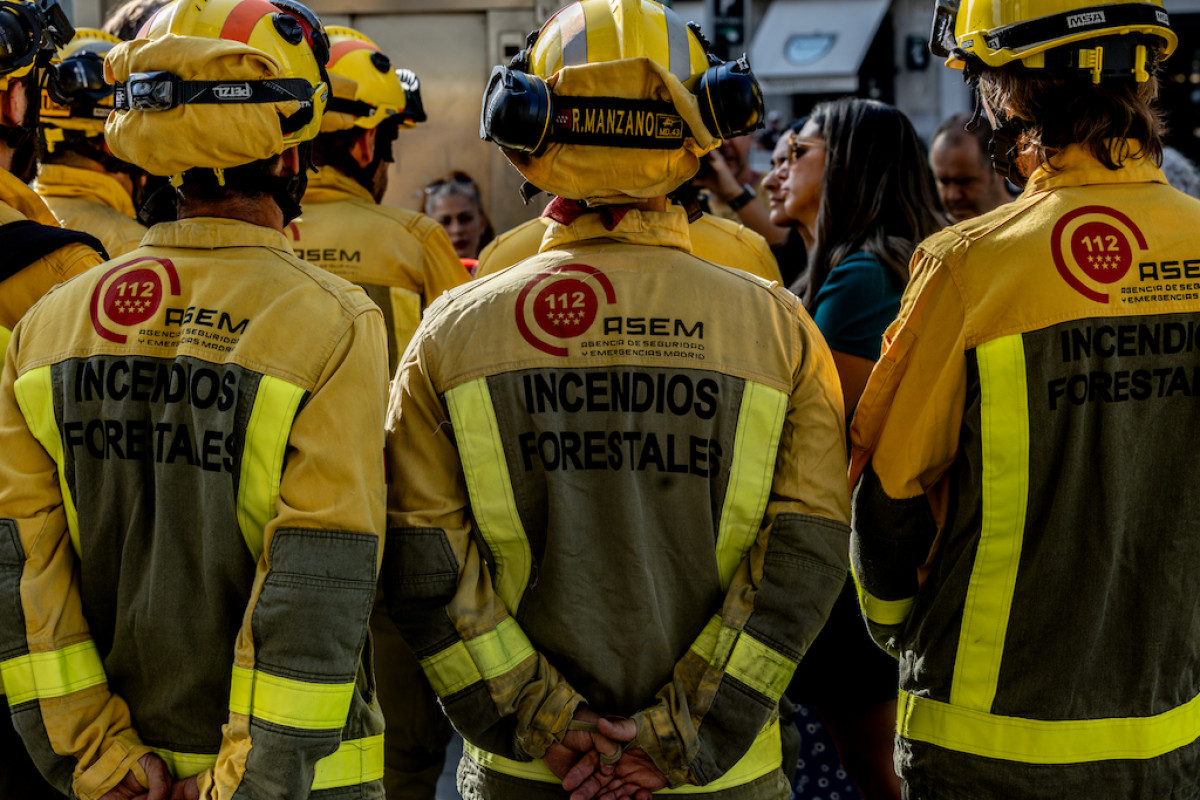
August 2025. The wildfires affecting with particular severity the provinces of Cáceres, Cádiz, León, Ourense, Ourense, Toledo or Zamora once again underline a structural problem that repeats every summer: a severe lack of resources, reluctance to develop preventive policies, and poor coordination among administrations. On paper, the system seems to work; in the field, the smoke of structural shortcomings is as dramatic as that of the forests burning. The response to the infernal summer is delivered from a reactive approach that experts and ecologists criticize each year, with the slogan that “fires are put out in winter.” Spending, governance and management are the dimensions of this analysis.
“At the end of the peak season, numerous contracts are not renewed (between 70-90%, depending on the community) and, with them, operational capacity is lost just in the lead‑up period.”
Firefighters, technicians and forest brigades agree, insisting year after year, that the material and human resources are insufficient. They are so because the budgets allocated to these items are scarce and have generally shrunk for two decades. There are also huge differences between autonomous communities: from 20€/hectare in Castile and León, to nearly 90€/hectare in Andalusia. That deficit extends to logistics and to the stability of staffing, weakened by temporality and outsourcing. Part of prevention and extinction tasks have been handed to private companies or public-business entities that operate under temporary contracts. At the end of the peak season, numerous contracts are not renewed (between 70-90%, depending on the community) and, with them, operational capacity is lost precisely in the pre‑season period. In addition, professionals work with tight budgets and low wages, which adds precariousness to risk and to exhaustion.
The “off‑season” for fires thus becomes an off‑season for contracts. This year, the abundant spring rains increased vegetation and, with it, the forest fuel load. Territorial management experts warned publicly that preventive measures before summer were necessary, such as clearing critical areas or reducing biomass, because combined with the heat of the season it would be explosive. A good opportunity to once again argue that technical knowledge in many policy areas is there; yes, it was possible to know and, therefore, to act accordingly.
The existence of laws and autonomous plans provides a sense of foresight and good management, but that regulatory forest does not always translate into effective capacities. Without stable units, without well‑funded first‑response resources, laws are little more than statements of intent. In this context, the Military Emergency Unit has shifted from being a temporary reinforcement to, in practice, becoming the main national instrument of civil protection. This shift in responsibilities reflects a dangerous inertia: entrusting intervention to a “seventh cavalry.” It is not a debate about its effectiveness—the UME acts with considerable professionalism—or about sterile inter‑agency jealousy—though it exists—but about the reduced incentives for some regional administrations to maintain and strengthen their own capacity to respond without waiting for state reinforcements. This is one of the political “traps” of the UME that we have pointed out in this paper.
Autonomous communities, provincial councils, municipalities, the General State Administration and public or private companies operate within their respective duties, but in practice the actual functioning diverges from the coordinated model planned. The criticisms from technical leaders also point to this serious deficit. As I stressed regarding the catastrophic DANA in Valencia or the “national blackout” this past April, the national civil protection system — of which a new national strategy was published in 2024 — requires a major step forward to guarantee loyal cooperation. The jokes and memes on social networks from public officials do not fill one with optimism.
The case of the forest fires illustrates a broader problem of national security policy that, in this field of competences, is fundamentally regional: the need to move from a reactive approach to a preventive one, based on long‑term planning and sustained resource allocation. This requires permanent structures, joint operating protocols and a system of ongoing evaluation that does not depend on media pressure or the urgency of the moment. Investment in prevention does not yield immediate visible results; it is not glamorous in electoral terms. Yet it is the only way to reduce the magnitude of damages and to improve the protection of people and of natural heritage. Therefore, I argued that the second pillar of the discussion about spending on (misnamed) defense, that is, that 1.5% of GDP in security, offered an excellent opportunity, and justification, to channel political will in this direction.
“Investment in prevention is not glamorous in electoral terms. The discussion about defense spending, that is, that 1.5% of GDP in security, offered an excellent opportunity to channel political will in this direction.”
The climatic variable worsens the situation. Spain must rethink its security in these terms, as has been argued here. The fires, whether provoked or accidental, now unfold within a context more conducive to their rapid spread and virulence. Moreover, changes in the use (or abuse) of rural, but also urban, space impose a scenario in which the capacity to respond must be constant, not seasonal. Nature amplifies the consequences of human decisions, both those made and those postponed.
We will continue to endure catastrophic natural episodes. Therefore, it would be worthwhile to propose a single risk‑planning framework that integrates state, regional and local competences, increases steady funding for first‑intervention units, and ensures that prevention becomes an operational obligation. Similarly, the technical evaluation of each major fire should be mandatory, with public reports that allow correcting failures and optimizing resources. In short, to establish a system that acts effectively before, during and after the emergency.
