
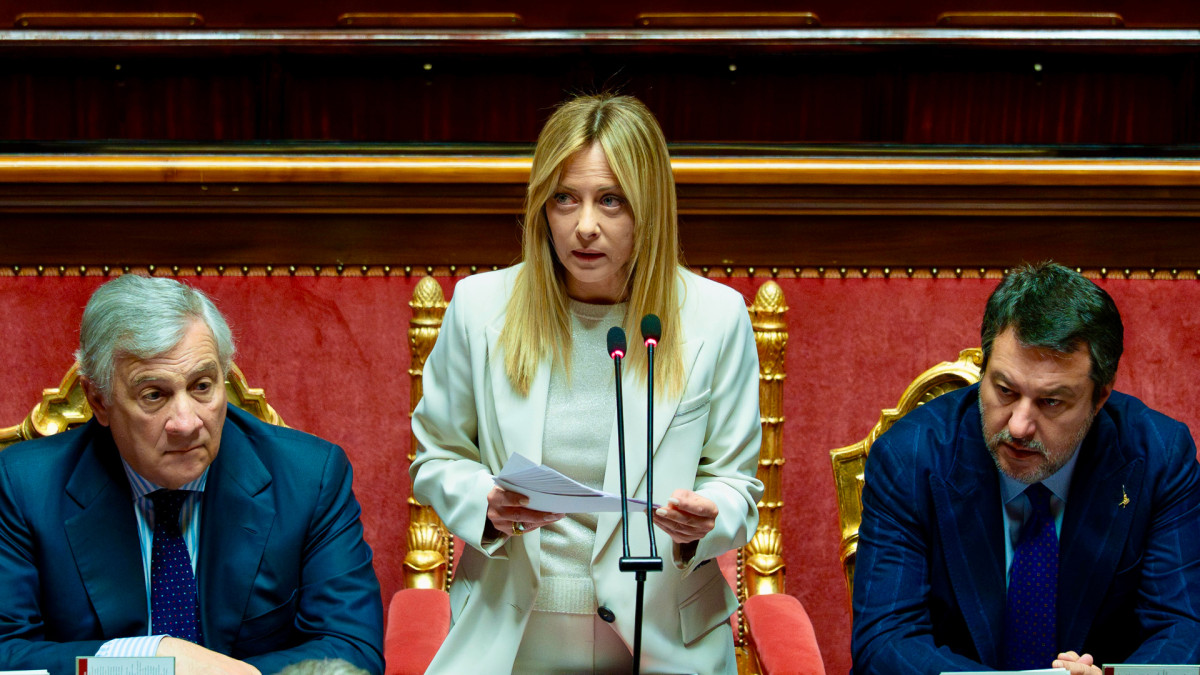
Giorgia Meloni’s defeat in the March 22 and 23 referendum on justice has sparked a debate about whether there should be a call for early general elections. Legally, losing a constitutional reform referendum does not oblige the government to resign nor does it force new elections: of the five referendums held, Silvio Berlusconi — who lost the 2006 referendum — did neither resign nor propose going to new elections, and Matteo Renzi — defeated in the 2016 referendum — did submit his resignation, but there were no early elections. Meloni had already stated before the referendum that she would not resign under any circumstances and also ruled out asking the President of the Republic, Sergio Mattarella, to dissolve Parliament.
In any case, the defeat in the referendum has intensified latent internal contradictions in Meloni’s government, which is somewhat dissatisfied with the performance of the current team. On one side, the governing coalition shows signs of wear, and on the other, the Lega is uneasy about Roberto Vannacci’s challenge, while in Forza Italia Marina Berlusconi desires a thorough remodeling of the party. The major conflict has arisen with Daniela Santanché, the Tourism Minister, whose resignation, demanded by Meloni, was not easy given her resistance. Finally, she was accompanied in her dismissal by Giusi Bartolozzi, head of the Justice Ministry’s Cabinet, and Andrea Delmastro, the deputy minister of the same portfolio, while Maurizio Gasparri, the Forza Italia spokesman in the Senate, submitted his resignation. All of this suggests that the top official in charge of justice, Carlo Nordio, may have his hours numbered, since the responsibility has fallen largely on the Ministry’s team for the referendum’s failure.
“Trying to push for early elections seems like a leap forward and it is not clear that, after the referendum defeat, it would be the best scenario.”
In these circumstances, it seems the possibility of going to early elections is being weighed. It is an option that carries risks, although, if it did occur and Meloni managed to reaffirm her majority, she would emerge much stronger. Moreover, there are doubts about the timing of the dissolution: June so as to be able to present the budgets afterward? Or October with a new electoral law?
In short, attempting to force early elections seems a leap forward and it is not clear that, after the referendum defeat, it would be the best scenario, while keeping the current government team in place until 2027 could involve substantial wear. It is true that an early vote would complicate the centre-left’s alternative, which for now lacks a shared program and a clear leader, but one cannot ignore European circumstances (the risk that Italy could be warned by European authorities for an excessive deficit) and international ones (the right’s support for Donald Trump is becoming more troublesome in light of his erratic conduct in the Iran conflict).
What political and electoral risks would an early election pose for Meloni?
Consequently, proposing early elections presents both advantages and disadvantages: it could catch the opposition off guard, but there are many more drawbacks. First, the economic situation is fragile, with signs of a recession in Italy (a 0.6% drop in industrial output), rising inflation, increasing fuel prices, Confindustria has rejected a government fiscal decree, and the new budgets are in limbo. Furthermore, moving up elections would mean not honoring one of Meloni’s promises to serve out the legislature (if she remains in government, by September 4 she will have surpassed Berlusconi II’s record). Additionally, in the Italian constitutional system, the power to dissolve early lies with the President, and it does not seem that Mattarella is inclined: there is already a clear parliamentary majority supporting the government, and the delicate and complex international situation does not advise such a move. Finally, and not a minor issue, it would be very risky for Meloni to go to new elections with the current electoral law (Rosatellum), since several simulations show that Meloni’s coalition might not revalidate its current majority. Therefore, Meloni is eager to see her electoral reform (the Stabilicum) approved as soon as possible, among other factors because she has a majority to do so, but it remains to be seen whether she can achieve it in the very short term as she intends.
Officially, Fratelli d’Italia states through Francesco Lollobrigida, the Minister of Agriculture, that the scenario of early elections non mi risulta, which in political jargon can be interpreted as all or nothing. The Lega also shows little interest, although an early vote could complicate Roberto Vannacci’s expectations, with whom they intend to compete by further radicalizing their right-wing stance. Antonio Tajani, from Forza Italia, views the hypothesis of early elections as mere speculation with little substance, given that his party is undergoing internal restructuring. Not insignificant would be the problems for the opposition (Democratic Party, Five Star Movement, Green-Left Alliance and Italia Viva) because they lack a common line, a consensual program, and a clear leader (the rivalry between Elly Schlein and Giuseppe Conte), and it is unclear how such a leader would be chosen (primaries? crown-of-the-party agreement?).
Poll averages do not guarantee a very favorable outcome for Meloni either: Fratelli d’Italia 26.7% (27% in 2022), Lega 8.3% (8.8% in 2022), Forza Italia 9.5% (8.2% in 2022). For the opposition: Democratic Party 22% (19% in 2022), Five Star Movement 14.2% (15.5% in 2022) (YouTrend polls of March 26 and IPSOS, analyzed by Nando Pagnoncelli in Corriere della Sera on March 29). In short, the right-wing bloc would hover around 46% and the opposition around 43%, and another noteworthy data point is the personal trust in the leaders: Meloni drops from 44% to 40%, Tajani remains at 32%, Conte stays at 30%, Schlein rises from 23% to 26%, and Salvini falls from 24% to 22%.
In conclusion, an early election is not impossible, but it seems unlikely, while a government reshuffle of varying scope into the near future is almost certain due to the internal party balances and the distribution of ministries, which are always the subject of intense disputes.
